Summary

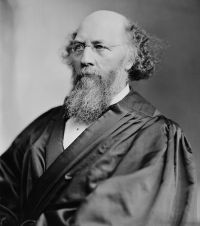
Portrait of Stephen Johnson Field Stephen Johnson Field United States v. Circuit Judges…

There is no repugnancy between the acts of 1851 and 1864. Reading them together, it would seem to be clear that Congress intended that when a case was decided by the District Court an appeal should lie; but when decided by the Circuit Court, its decision should be final. There is nothing singular in a provision of this kind, and if there were, it is sufficient that such was the will of the legislature. In matters of survey, which oftentimes determine the value of the whole claim, the decision of the Circuit Court is admitted to be final, made so in express terms by the act.
Source: Wikisource

Portrait of Stephen Johnson Field Stephen Johnson Field United States v. Circuit Judges…

The Supreme Court, by the Constitution, takes its appellate jurisdiction over cases 'with such exceptions, and under such regulations as the Congress shall make.' And the designation, by acts of Congress, of the cases to which this jurisdiction shall extend, has uniformly been held to be a legislative declaration that all other cases are excepted from it.
Source: Wikisource

Portrait of Stephen Johnson Field Stephen Johnson Field United States v. Circuit Judges…

Though the principles of equity are to constitute one ground of the decision, the proceeding has nothing in it whatever which will justify its designation as a suit in equity as those terms are used in the act of 1803.
The heads of the different departments are often required by acts or resolutions of Congress to settle claims for losses and liabilities incurred on behalf of the government, or in the attempted performance of contracts on the principles of equity.
Source: Wikisource

Get perspective with Kwize: daily news enlightened by great literature