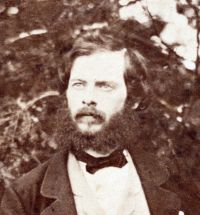
Theodore Winthrop

Theodore Winthrop

Summary

Portrait of Theodore Winthrop Theodore Winthrop Isthmiana — Chitres

The hammock to a bed is what flying is to walking. Here a stratum of cool air surrounded us, and the close packing of the boat was forgotten.
From my hammock in the porch I could look out upon the fair landscape Arcadian, over the exquisitely undulating greensward, unbroken as far as the eye could reach, except by the scattered huts and their small enclosures. Each of these was marked by its rich grove of orangetrees, and its shading, ever-tremulous cocoa-palms. Cattle, droves of horses, and all the smaller domestic animals, strayed about.
Source: Wikisource

Portrait of Theodore Winthrop Theodore Winthrop Isthmiana — Chitres

The Padron was an excellent fellow, and merited his good fortune in having a most charming wife, one of the most exquisite persons I have ever seen, of delicate features, a pure, dark complexion, brilliant, with a dark flush. Her younger sister was even more delicate and sylph-like; I was tempted to stay and forget civilization in her society; I am sorry I did not.
They brought us oranges, and sounds of gasping chickens were heard from the poultry-yard. We hung our hammocks, and reposed. I have spoken of the compensations of Nature. Among these, and foremost, let me not forget the hammock.
Source: Wikisource

Portrait of Theodore Winthrop Theodore Winthrop Isthmiana — Chitres

Near every house is a hanging garden on a small scale, a bed of earth raised six or seven feet on poles, for protection from cattle and reptiles, and planted with onions and vegetables. Occasionally, also, we found plantations of rice and maize. The latter gives three crops a year. Troops of pack animals constantly passed us, laden with enormous hide ceroons, filled with grain.
Source: Wikisource

Get perspective with Kwize: daily news enlightened by great literature