Summary

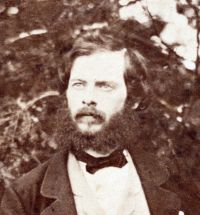
Portrait of Theodore Winthrop Theodore Winthrop John Brent — Chapter XI. Father and Daughter

We are very fond of scenery, sir, my daughter and I, and this breadth of effect is very impressive after England. England, you know, sir, is tame, — a snug little place, but quite a prison for people of scope. Lancashire, my old home, is very pretty, but not grand; quite the contrary. I have grown really quite tired of green grass, and well-kept lawns, and the shaved, beardless, effeminate look of my native country. This rough nature is masculine. It reminds me of the youth of the world. I like to be in the presence of strong forces.
Source: Wikisource

Portrait of Theodore Winthrop Theodore Winthrop John Brent — Chapter XI. Father and Daughter

The circle of wagons, the groups of Saints about their supper fires, the cattle and the fort in the distance, made a strangely unreal background to a woman whose proper place, for open air, was in the ancient avenue of some ancestral park, or standing on the terrace to receive groups of brilliant ladies coming up the lawn. But character is superior to circumstance, and Miss Clitheroe’s self-possession controlled her scenery.
Source: Wikisource

Portrait of Theodore Winthrop Theodore Winthrop John Brent — Chapter XI. Father and Daughter

O beauty! beware, or do not beware, just as you deem best, but know that there is peril! For love can improvise out of the steam of a teapot a romance as big and sudden and irrepressible as the Afreet that swelled from the casket by the sea-shore in the Arabian story.
We sat down upon the grass for our picnic. I should not invite the late Mr. Watteau, or even the extant Mr. Diaz, to paint us. The late Mr. Watteau’s heroes and heroines were silk and satin Arcadians; they had valets de chambre and filles de chambre, and therefore could be not fully heroes and heroines, if proverbs be true.
Source: Wikisource

Get perspective with Kwize: daily news enlightened by great literature