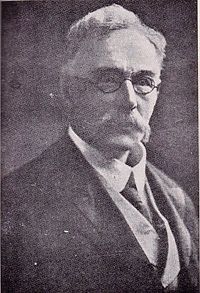
Thomas William Rhys Davids

Thomas William Rhys Davids

Summary

Portrait of Thomas William Rhys Davids Thomas William Rhys Davids 1911 Encyclopædia Britannica, Volume 16… (1911)

The older school had taught that Gotama, who had propounded the doctrine of Arahatship, was a Buddha, that only a Buddha is capable of discovering that doctrine, and that a Buddha is a man who by self-denying efforts, continued through many hundreds of different births, has acquired the so-called Ten Pāramitās or cardinal virtues in such perfection that he is able, when sin and ignorance have gained the upper hand throughout the world, to save the human race from impending ruin.
Source: Wikisource

Portrait of Thomas William Rhys Davids Thomas William Rhys Davids 1911 Encyclopædia Britannica, Volume 16… (1911)

Now the older school also held, in the first place, that, when a man had, in this life, attained to Arahatship, his karma would not pass on to any other individual in another life—or in other words, that after Arahatship there would be no rebirth; and, secondly, that four thousand years after the Buddha had proclaimed the Dhamma or doctrine of Arahatship, his teaching would have died away, and another Buddha would be required to bring mankind once more to a knowledge of the truth.
Source: Wikisource

Portrait of Thomas William Rhys Davids Thomas William Rhys Davids 1911 Encyclopædia Britannica, Volume 16… (1911)

LĀMĀISM, a system of doctrine partly religious, partly political. Religiously it is the corrupt form of Buddhism prevalent in Tibet and Mongolia. It stands in a relationship to primitive Buddhism similar to that in which Roman Catholicism, so long as the temporal power of the pope was still in existence, stood to primitive Christianity. The ethical and metaphysical ideas most conspicuous in the doctrines of Lāmāism are not confined to the highlands of central Asia, they are accepted in great measure also in Japan and China.
Source: Wikisource

Get perspective with Kwize: daily news enlightened by great literature