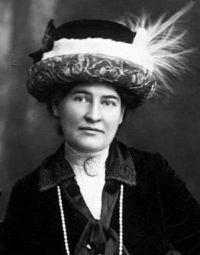
Willa Sibert Cather

Willa Sibert Cather

Summary

Portrait of Willa Sibert Cather Willa Sibert Cather My Ántonia — Book 5

Ántonia coming in with her work-team along the evening sky-line. She lent herself to immemorial human attitudes which we recognize by instinct as universal and true. I had not been mistaken. She was a battered woman now, not a lovely girl; but she still had that something which fires the imagination, could still stop one's breath for a moment by a look or gesture that somehow revealed the meaning in common things. She had only to stand in the orchard, to put her hand on a little crab tree and look up at the apples, to make you feel the goodness of planting and tending and harvesting at last.
Source: Wikisource

Portrait of Willa Sibert Cather Willa Sibert Cather My Ántonia — Book 5

Ántonia leaned her elbows on the table. There was the deepest peace in that orchard. It was surrounded by a triple enclosure; the wire fence, then the hedge of thorny locusts, then the mulberry hedge which kept out the hot winds of summer and held fast to the protecting snows of winter. The hedges were so tall that we could see nothing but the blue sky above them, neither the barn roof nor the windmill. The afternoon sun poured down on us through the drying grape leaves. The orchard seemed full of sun, like a cup, and we could smell the ripe apples on the trees.
Source: Wikisource

Portrait of Willa Sibert Cather Willa Sibert Cather My Ántonia — Book 5

I was thinking about Ántonia and her children; about Anna's solicitude for her, Ambrosch's grave affection, Leo's jealous, animal little love. That moment, when they all came tumbling out of the cave into the light, was a sight any man might have come far to see. Ántonia had always been one to leave images in the mind that did not fade—that grew stronger with time.
Source: Wikisource

Get perspective with Kwize: daily news enlightened by great literature