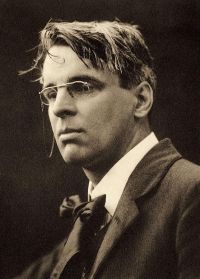
William Butler Yeats

William Butler Yeats

../../../ (1926)

Summary

Portrait of William Butler Yeats William Butler Yeats,  ../../../ (1926)

“ If you work in a storm of atoms and seconds, if your highest joy is ‘life; London; this moment in June’ and your deepest mystery ‘ here is one room; there another’, then how can you construct your human beings so that each shall be not a movable monument but an abiding home, how can you build between them any permanent roads of love and hate? There was continuous life in the little hotel people of The Voyage Out because there was no innovation in the method. But Jacob in Jacob’s Room is discontinuous, demanding—and obtaining—separate approval for everything he feels or does. ”
Source: Wikisource

Portrait of William Butler Yeats William Butler Yeats,  ../../../ (1926)

“ So at least one would suppose, and that is why the novel of Jacob's Room (1922) comes as a tremendous surprise. The impossible has occurred. The style closely resembles that of Kew Gardens. The blobs of colour continue to drift past; but in their midst, interrupting their course like a closely sealed jar, rises the solid figure of a young man. In what sense Jacob is alive—in what sense any of Virginia Woolf's characters live—we have yet to determine. ”
Source: Wikisource

Portrait of William Butler Yeats William Butler Yeats,  ../../../ (1926)

“ Plato’s argument is stowed away in Jacob’s mind, and for five minutes Jacob’s mind continues alone, onwards, into the darkness. Then, getting up, he parted the curtains, and saw, with astonishing clearness, how the Springetts opposite had gone to bed; how it rained; how the Jews and the foreign woman, at the end of the street, stood by the pillar-box, arguing. It is easy for a novelist to describe what a character thinks of; look at Mrs. Humphrey Ward. But to convey the actual process of thinking is a creative feat, and I know of no one except Virginia Woolf who has accomplished it. ”
Source: Wikisource

Get perspective with Kwize: daily news enlightened by great literature