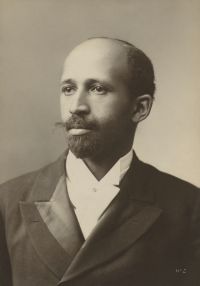
William Edward Burghardt Du Bois

William Edward Burghardt Du Bois

Summary

Portrait of William Edward Burghardt Du Bois William Edward Burghardt Du Bois Listen to the 1903 version of this text

It is a peculiar sensation, this double-consciousness, this sense of always looking at one's self through the eyes of others, of measuring one's soul by the tape of a world that looks on in amused contempt and pity. One ever feels his two-ness,—an American, a Negro; two souls, two thoughts, two unreconciled strivings; two warring ideals in one dark body, whose dogged strength alone keeps it from being torn asunder. The history of the American Negro is the history of this strife,—this longing to attain self-conscious manhood, to merge his double self into a better and truer self.
Source: Wikisource

Portrait of William Edward Burghardt Du Bois William Edward Burghardt Du Bois Listen to the 1903 version of this text

Thus the second decade of the American Negro's freedom was a period of conflict, of inspiration and doubt, of faith and vain questionings, of Sturm und Drang. The ideals of physical freedom, of political power, of school training, as separate all-sufficient panaceas for social ills, became in the third decade dim and overcast. They were the vain dreams of credulous race childhood; not wrong, but incomplete and over-simple. The training of the schools we need to-day more than ever,—the training of deft hands, quick eyes and ears, and the broader, deeper, higher culture of gifted minds.
Source: Wikisource

Portrait of William Edward Burghardt Du Bois William Edward Burghardt Du Bois Listen to the 1903 version of this text

A people thus handicapped ought not to be asked to race with the world, but rather allowed to give all its time and thought to its own social problems. But alas! while sociologists gleefully count his bastards and his prostitutes, the very soul of the toiling, sweating black man is darkened by the shadow of a vast despair. Men call the shadow prejudice, and learnedly explain it as the natural defense of culture against barbarism, learning against ignorance, purity against crime, the "higher" against the "lower" races. To which the Negro cries Amen!
Source: Wikisource

Get perspective with Kwize: daily news enlightened by great literature