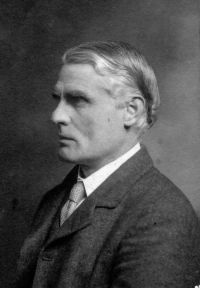
William Herrick Macaulay

William Herrick Macaulay

Summary

Portrait of William Herrick Macaulay William Herrick Macaulay 1911 Encyclopædia Britannica (1911)

The Galileo-Newton theory of motion is that, relative to a suitably chosen base, and with suitable assignments of mass, all accelerations of particles are made up of mutual (so-called) actions between pairs of particles, whereby the two particles forming a pair have accelerations in opposite directions in the line joining them, of magnitudes inversely proportional to their masses. The total acceleration of any particle is that obtained by the superposition of the component accelerations derived from its association with the other particles of the system severally in accordance with this law.
Source: Wikisource

Portrait of William Herrick Macaulay William Herrick Macaulay 1911 Encyclopædia Britannica (1911)

The acceleration of a falling body is naturally attributed to the presence of the earth; and, though the body approaches the earth in the course of its fall, it is easily recognized that the conditions under which it moves are only very slightly affected by this approach. Moreover, Galileo recognized, to some extent at any rate, the principle of simple superposition of velocities and accelerations due to different sets of circumstances, when these are combined (see Mechanics) . The results thus obtained apply to the motion of a small body, the rotation of which is disregarded.
Source: Wikisource

Portrait of William Herrick Macaulay William Herrick Macaulay 1911 Encyclopædia Britannica (1911)

The mass of a body is often loosely defined as the measure of the quantity of matter in it. This definition correctly indicates that the mass of any portion of matter is equal to the sum of the masses of its parts, and that the masses of bodies alike in other respects are equal, but gives no test for comparison of the masses of bodies of different substances
Source: Wikisource

Get perspective with Kwize: daily news enlightened by great literature