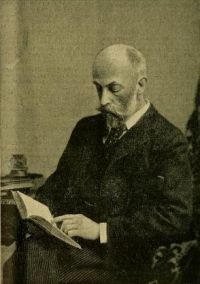
William Turner Thiselton-Dyer

William Turner Thiselton-Dyer

Summary

Portrait of William Turner Thiselton-Dyer William Turner Thiselton-Dyer Dictionary of National Biography… (1912)

Writing to Lyell in 1866, Darwin said: 'his [Hooker's] mind is so acute and critical that I always expect to hear a torrent of objections to anything proposed; but he is so candid that he often comes round in a year or two' (M. L. ii. 138) .
Darwin and Hooker were both ultimately inspired by Lyell. Darwin's problem was how species originate; Hooker's how they are distributed over the surface of the earth.
Source: Wikisource

Portrait of William Turner Thiselton-Dyer William Turner Thiselton-Dyer Dictionary of National Biography… (1912)

The permanence of species was substantially the belief with which Darwin, Hooker, and Huxley started on their expeditions. Fossil remains in South America convinced Darwin that the present inhabitants of a given area though similar were not identical with their predecessors in the pant; there had been an evolution in time. The animals and plants (worked out by Hooker in 1845-6) of the Galapagos, though related, differed in each island; the inevitable conclusion was that there had been an evolution in space. Species were clearly not permanent
Source: Wikisource

Portrait of William Turner Thiselton-Dyer William Turner Thiselton-Dyer Dictionary of National Biography… (1912)

Four months earlier Hooker published his 'Introductory Essay on the Flora of Tasmania,' by far the most noteworthy of his speculative writings. In this he frankly adopts, in view of the Darwin-Wallace theory, the hypothesis 'that species are derivative and mutable.' The essay is in other respects remarkable for the first sketch of a rational theory of the geographical distribution of plants, besides giving a masterly analysis of the Australian flora.
Source: Wikisource

Get perspective with Kwize: daily news enlightened by great literature