William Turner Thiselton-Dyer

Biographical details

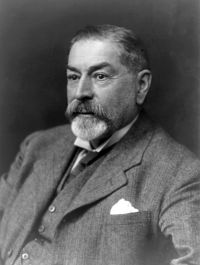
Portrait of William Turner Thiselton-Dyer William Turner Thiselton-Dyer 1911 Encyclopædia Britannica (1911)

Huxley, however, felt that he had at last a secure grip of evolution. He warned Darwin: “I will stop at no point as long as clear reasoning will carry me further” (Life, i. 172) . Owen, who had some evolutionary tendencies, was at first favourably disposed to Darwin’s theory, and even claimed that he had to some extent anticipated it in his own writings. But Darwin, though he did not thrust it into the foreground, never flinched from recognizing that man could not be excluded from his theory.
Source: Wikisource

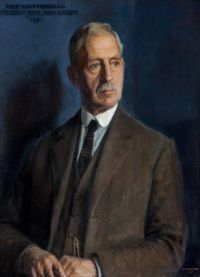
Portrait of William Turner Thiselton-Dyer William Turner Thiselton-Dyer 1911 Encyclopædia Britannica (1911)

Though Huxley had accepted the Darwinian theory as a working hypothesis, he never succeeded in firmly grasping it in detail. He thought “evolution might conceivably have taken place without the development of groups possessing the characters of species” (Essays, v. 41) . His palaeontological researches ultimately led him to dispense with Darwin. In 1892 he wrote: “The doctrine of evolution is no speculation, but a generalization of certain facts .
Source: Wikisource

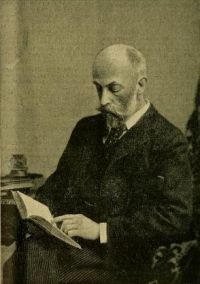
Portrait of William Turner Thiselton-Dyer William Turner Thiselton-Dyer Dictionary of National Biography… (1912)

Writing to Lyell in 1866, Darwin said: 'his [Hooker's] mind is so acute and critical that I always expect to hear a torrent of objections to anything proposed; but he is so candid that he often comes round in a year or two' (M. L. ii. 138) .
Darwin and Hooker were both ultimately inspired by Lyell. Darwin's problem was how species originate; Hooker's how they are distributed over the surface of the earth.
Source: Wikisource

Get perspective with Kwize: daily news enlightened by great literature