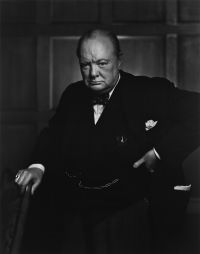
Winston Leonard Spencer Churchill

Winston Leonard Spencer Churchill

Summary

Portrait of Winston Leonard Spencer Churchill Winston Leonard Spencer Churchill London to Ladysmith via Pretoria… (1900)

When at last the sun sank behind the fort upon the hill and twilight marked the end of another wretched day, I used to walk up and down the courtyard looking reflectively at the dirty, unkempt 'zarps' who stood on guard, racking my brains to find some way, by force or fraud, by steel or gold, of regaining my freedom. Little did these Transvaal Policemen think, as they leaned on their rifles, smoking and watching the 'tame officers,' of the dark schemes of which they were the object, or of the peril in which they would stand but for the difficulties that lay beyond the wall.
Source: Wikisource

Portrait of Winston Leonard Spencer Churchill Winston Leonard Spencer Churchill London to Ladysmith via Pretoria… (1900)

Sometimes we get a little fillip of excitement. One evening, as I was leaning over the railings, more than forty yards from the nearest sentry, a short man with a red moustache walked quickly down the street, followed by two colley dogs. As he passed, but without altering his pace in the slightest, or even looking towards me, he said quite distinctly 'Methuen beat the Boers to hell at Belmont.' That night the air seemed cooler and the courtyard larger. Already we imagined the Republics collapsing and the bayonets of the Queen's Guards in the streets of Pretoria.
Source: Wikisource

Portrait of Winston Leonard Spencer Churchill Winston Leonard Spencer Churchill London to Ladysmith via Pretoria… (1900)

It was, as nearly as I can remember, midday when the train-load of prisoners reached Pretoria. We pulled up in a sort of siding with an earth platform on the right side which opened into the streets of the town. The day was fine, and the sun shone brightly. There was a considerable crowd of people to receive us; ugly women with bright parasols, loafers and ragamuffins, fat burghers too heavy to ride at the front, and a long line of untidy, white-helmeted policemen—'zarps' as they were called—who looked like broken-down constabulary.
Source: Wikisource

Get perspective with Kwize: daily news enlightened by great literature