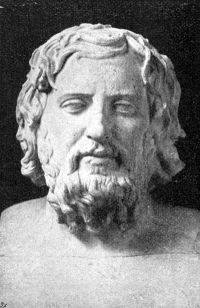
“ To win victories over private persons in a chariot race does not add one tittle to a man's renown. He, rather, who holds his city dear beyond all things else, who has himself sunk deep into the heart of her affections, who has obtained to himself all over the world a host of friends and those the noblest, who can outdo his country and comrades alike in the race of kindliness, and his antagonists in vengeance—such a man may, in a true sense, be said to bear away the palm of victory in conquests noble and magnificent ”
Summary

Quotes from Agesilaus (Xenophon)
“ Never, I suppose, was there a foeman whose removal came with a greater sense of relief to the enemy than that of Agesilaus, though a veteran when he died. Never was there a leader who inspired stouter courage in the hearts of fellow-combatants than this man with one foot planted in the grave. Never was a young man snatched from a circle of loving friends with tenderer regret than this old graybeard.The benefactor of his fatherland, absolutely to the very end ”
“ And, as touching the things of Aphrodite, if for nothing else, at any rate for the marvel of it, the self-restraint of the man deserves to be put on record. It is easy to say that to abstain from that which excites no desire is but human; yet in the case of Megabates, the son of Spithridates, he was moved by as genuine a love as any passionate soul may feel for what is lovely. Now, it being a national custom among the Persians to salute those whom they honour with a kiss, Megabates endeavoured so to salute Agesilaus, but the latter with much show of battle, resisted—"No kiss might he accept." ”
“ He had taken pains to enable his soldiers to undergo the fatigue of war, he had filled their breasts with a proud consciousness that they were equal to do battle with any combatants in the world, and what was more, he had infused a wholesome rivalry in those about him to prove themselves each better than the rest. ”
“ During the whole of his career no charge of fraudulent dealing was ever lodged against Agesilaus; against which set the many-voiced acknowledgment of countless benefits received from him. A man who found pleasure in giving away his own for the benefit of others was not the man to rob another of his goods at the price of infamy. Had he suffered from this thirst for riches it would have been easier to cling to what belonged to him than to take that to which he had no just title. ”
“ Surely if one man rather than another may be accounted truly blest, it is he who, from his boyhood upwards, thirsted for glory, and beyond all contemporary names won what he desired; who, being gifted with a nature most emulous of honour, remained from the moment he was king unconquered ”
“ And whenever he brought over a city to his side, he set the citizens free from the harsher service of a bondsman to his lord, imposing the gentler obedience of a freeman to his ruler. Indeed, there were fortresses impregnable to assault which he brought under his power by the subtler force of human kindness.But when, in Phrygia even, the freedom of his march along the flats was hampered by the cavalry of Pharnabazus, he saw that if he wished to avoid a skulking warfare under cover, a force of cavalry was indispensable. ”
“ This was the signal for a flight so extraordinary that dead and dying lined the road, and the living were captured wholesale, nor was a halt made until the pursuers reached Mount Narthacius. Here, midway between Pras and Narthacius, Agesilaus erected a trophy, and here for the moment he halted in unfeigned satisfaction at his exploit, since it was from an antagonist boasting the finest cavalry in the world that he had wrested victory with a body of cavalry organised by himself. ”
“ Nor, in my opinion, were those obscure proofs of courage and true manliness which he furnished by his readiness ever to wage war against the strongest enemies, whether of Sparta or of Hellas, placing himself in the forefront of the contests decided on. If the enemy cared to join issue in fair field he would not chance upon a victory won by panic, but in stubborn battle, blow for blow, he mastered him ”
“ As to Agesilaus no eye-witness has ever reported any unworthy behaviour, nor, had he invented it, would his tale have found credence, since it was not the habit of the king, when abroad, to lodge apart in private houses. He always lay up in some sacred place, where behaviour of the sort was out of the question, or else in public, with the eyes of all men liable to be called as witnesses to his sobriety. For myself, if I make these statements falsely against the knowledge of Hellas, this were not in any sense to praise my hero, but to dispraise myself. ”
“ But seeing that contempt for the foe is calculated to infuse a certain strength in face of battle, he ordered his criers to strip naked the barbarians captured by his foraging parties, and so to sell them. The soldiers who saw the white skins of these folk, unused to strip for toil, soft and sleek and lazy-looking, as of people who could only stir abroad in carriages, concluded that a war with women would scarcely be more formidable. ”
“ No citizen could be his personal foe; of that he was assured. His desire was to commend them one and all alike, counting the common salvation of all a gain, and reckoning it as a loss if even a mean man perished. For thus he reasoned, nor made a secret of the conclusion he had come to: so long as her citizens continued tranquilly adherent to the laws the happiness of Sparta was secure. [73] And for the rest Sparta would once again be strong on that day when the states of Hellas should learn wisdom. ”
“ I To write the praises of Agesilaus in language equalling his virtue and renown is, I know, no easy task; yet must it be essayed; since it were but an ill requital of pre-eminence, that, on the ground of his perfection, a good man should forfeit the tribute even of imperfect praise. ”
“ And yet if it be a fine thing to hold a fortress impregnable to attack, I count it a greater glory that a man should hold the fortress of his soul inviolable against the assaults of riches, pleasures, fears. ”
“ And in these matters he was not like a man who chances upon a treasure and thereby becomes wealthier, albeit none the more skilful in economy; nor yet like him who, when a plague has fallen upon an enemy, wrests a victory, whereby he may add to his reputation for success, but not for strategy. ”
“ And as a matter of act Agesilaus judged it not only wrong to forgo repayment of a deed of kindness, but, where the means were ample, wrong also not to repay such debts with ample interest.The charge of embezzlement, could it be alleged, would no less outrage all reason in the case of one who made over to his country the benefit in full of grateful offerings owed solely to himself. Indeed the very fact that, when he wished to help the city or his friends with money, he might have done so by the aid of others, goes a long way to prove his indifference to the lure of riches ”
“ Rather was his example that of one who in each emergency will take the lead; at a crisis where toil is needful, by endurance; or in the battle-lists of bravery by prowess; or when the function of the counsellor is uppermost, by the soundness of his judgment. Of such a man I say, he has obtained by warrant indefeasible the title peerless.And if, as a means towards good workmanship, we count among the noble inventions of mankind the rule and the plummet, [96] no less happily shall we, who desire to attain a manly excellence, find in the virtue of Agesilaus a pattern and example. ”
“ How then shall we who imitate him become his opposite, unholy, unjust, tyrannical, licentious? And, truth to say, this man prided himself, not so much on being a king over others as on ruling himself, (2) not so much on leading his citizens to attack the enemy as on guiding them to embrace all virtue. (1) See Aeschin. "c. Ctes." p. 52, 25; Plat. "Phileb." 56 B. (2) See Plut. "Apophth. Lac." p. 104. Yet let it not be supposed, because he whom we praise has finished life, that our discourse must therefore be regarded as a funeral hymn. ”
“ Holding to the belief that the more satraps there were who revolted from the king the surer the gain to Hellas, he did not suffer himself to be seduced, either by gifts or by the mightiness in his power, to be drawn into bonds of friendship with the king, but took precaution rather not to abuse their confidence who were willing to revolt. ”
“ Forbearing to engage in the open field, where the gain would lie wholly with the enemy, he lay stoutly embattled on ground where the citizens must reap advantage; since, as he doggedly persisted, to march out meant to be surrounded on every side ”
“ And amongst these we must not deem them trophies alone which he actually set up, but reckon the many campaigns which he undertook, since they were victories truly, even when the enemy refused to encounter him, victories devoid of danger, yet fraught with even more solid advantage to the state of Sparta and her fellow-combatants; just as in our games we crown as victor him who walks over the field (2) no less than him who conquers by dint of battle. ”
“ He was ever subject to religious fear, [104] believing that no man during his lifetime, however well he lives, can be counted happy; it is only he who has ended his days with glory of whom it can be said that he has attained at last to blessedness. ”
“ He had filled all hearts with sanguine expectation of great blessings to descend on all, if they proved themselves good men. Such incentives, he thought, were best calculated to arouse enthusiasm in men's souls to engage in battle with the enemy. And in this expectation he was not deceived.I proceed to describe the battle, for in certain distinctive features it differed from all the battles of our day. The contending forces met on the plain of Coronea, Agesilaus and his troops approaching from the Cephisus, the Thebans and their allies from the slopes of the Helicon. ”
“ I suppose there is not one of all his doings but must illustrate it;--this man whose bearing towards his fatherland was such that by dint of implicit obedience [he grew to so greate a height of power] , [61] whose zeal in the service of his comrades won for him the unhesitating attachment of his friends, who infused into the hearts of his soldiers a spirit, not of discipline only, but of self-devotion to their chief. ”
“ As for riches, he employed them not with justice merely, but with liberality, holding that for a just man it is sufficient if he let alone the things of others, but of a liberal man it is required that he should take of his own and give to supply another's needs. ”
“ Again, if it is a sacred duty to hate the Persian, who of old set out on a campaign to enslave Hellas; the Persian, who to-day makes alliance with these (no matter to him which the party, provided it will help him to work the greater mischief (11) ) ; or gives presents to those (who will take them and do the greatest harm to his foes the Hellenes) ; or else concocts a peace that shall presently involve us in internecine war, as he anticipates:—but why dwell on facts so patent? —I ask, did ever Hellene before Agesilaus so enter heart and soul upon his duty ”
“ For the Persian, men must compass sea and land to discover some beverage which he will care to drink; he needs ten thousand pastrycooks to supply the kick-shaws he will deign to eat; and to procure him the blessing of sleep no tongue can describe what a world of trouble must be taken. But Agesilaus was a lover of toil, and therefore not so dainty ”
“ And now in battle order the rival squadrons faced each other; when the Thessalians, not liking a cavalry engagement in face of heavy infantry, wheeled and step by step retreated; their opponents with much demureness following. Then Agesilaus, detecting the common error under which both parties laboured, sent round his own bodyguard of stalwart troopers with orders to their predecessors (an order they would act upon themselves) to charge the enemy at full gallop and not give him a chance to rally. ”
“ The Argives did not even wait for Agesilaus and his division, but fled towards Helicon, and at that moment some of his foreign friends were on the point of crowning Agesilaus with the wreath of victory, when some one brought him word that the Thebans had cut through the division from Orchomenus and were busy with the baggage-train. Accordingly he at once deployed his division and advanced by counter-march against them. The Thebans on their side, seeing that their allies had scattered on Helicon, and eager to make their way back to join their friends, began advancing sturdily. ”
“ And so it came to pass that a truce was made, and Agesilaus departed homewards, having chosen, in lieu of supreme greatness in Asia, to rule, and to be ruled, in obedience to the laws at home.It was after this that his attention was drawn to the men of Argos. They had appropriated Corinth, and were reaping the fruits of their fields at home. The war to them was a merry jest. Accordingly he marched against them; and having ravaged their territory throughout, he crossed over by the pass down upon Corinth and captured the long walls leading to Lechaeum. ”
“ When Tissaphernes, priding himself on the strength of that army which had come down to aid him, bade Agesilaus to be gone from Asia or to prepare for war, [8] deep was the vexation depicted on the faces of the Lacedaemonians there present and their allies, as they realised that the scanty force of Agesilaus was all too small to cope with the armaments of Persia. ”
“ Agesilaus as holding this or that numerical descent from Heracles, and these ancestors no private persons, but kings sprung from the loins of kings. Nor is it open to the gainsayer to contend that they were kings indeed but of some chance city. Not so, but even as their family holds highest honour in their fatherland, so too is their city the most glorious in Hellas, whereby they hold, not primacy over the second best, but among leaders they have leadership. ”
“ Therefore his old age appeared mightier than the youth of other people. It would be hard to discover, I imagine, any one who in the prime of manhood was as formidable to his foes as Agesilaus when he had reached the limit of mortal life. ”
“ According to the historian, Agesilaus adopted similar tactics on both occasions (in B.C. 369 and B.C. 362 alike) . The encomiast after his manner appears to treat them as one. Once and again his hero "cunctando restituit rem," but it was by the same strategy. After the invading army had retired, no one will gainsay the sound sense of his behaviour. Old age debarred him from active service on foot or horse, and what the city chiefly needed now, he saw, was money, if she looked to gain allies. To the task therefore of providing that he set himself. ”
“ Your general asks you to keep yourselves on the alert in mind and body, as men about to enter the lists of battle on the instant." [13] But Tissaphernes was persuaded that this was all talk on his part for the purpose of outwitting him a second time: now certainly Agesilaus would make an incursion into Caria. So once again the satrap transported his infantry over into that country just has he had done before, and as before he posted his cavalry in the plain of the Maeander. ”
Common terms
Similar works
Hellenica (Xenophon) — Book 5, Chapter 4…Hellenica (Xenophon)Hellenica (Xenophon) — Book 6, Chapter 5…The Persian Wars — Book VII (Herodotus…Hellenica (Xenophon) — Book 6, Chapter 3…Plutarch's Lives — Pelopidas (Plutarch…Hellenica (Xenophon) — Book 3, Chapter 2…The History of Herodotus — Book VII: Called Polymnia…Plutarch's Lives — Lysander (Plutarch…The Public Orations of Demosthenes…
