Alexander Jannaeus

Definition and stakes

William Fairweather,  1911 Encyclopædia Britannica (1911)

“ Hyrcanus was succeeded by his son Aristobulus, whose reign of but one year was followed by that of his brother, the warlike Alexander Jannaeus (104–78) . The new king’s Sadducean proclivities rendered him odious to the populace, which rose in revolt, but only to bring upon itself a savage revenge. ”
Source: Wikisource

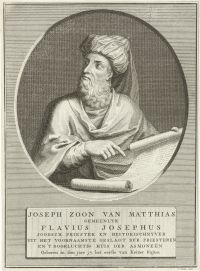
Portrait of Flavius Josephus Flavius Josephus,  Selections From Josephus

“ The Sadducees are influential only with the wealthy and have no following among the populace; the Pharisees have the masses on their side. But of these two sects and of the Essenes I have given a precise account in the second book of my Jewish (War) . [375] —Ant. XIII. 10. 5 f. (288-298) .
164 (57) "Conciliate the Pharisees"—Alexander’s dying advice to Alexandra Alexander Jannæus (of the Hasmonæan dynasty; reigned 104-78 B.C.) , on his last campaign, lies dying during the siege of Ragaba, near Gerasa on the east of Jordan.
”
Source: Gutenberg

E. M. Berens,  Myths and Legends of Ancient Greece and Rome

“ Janus is usually represented with two faces; in his special function as door-keeper of heaven he stands erect, bearing a key in one hand, and a rod or sceptre in the other.
It is supposed that Janus was the most ancient king of Italy, who, during his life, governed his subjects with such wisdom and moderation that, in gratitude for the benefits conferred upon them, his people deified him after death and placed him in the foremost rank among their divinities.
”
Source: Gutenberg

Get perspective with Kwize: daily news enlightened by great literature