Edmund Campion

Definition and stakes

Saint Edmund Campion Ten Reasons Proposed to His Adversaries for Disputation in the Name

When threatened with danger in one place the press was bodily transported to another.
However, our business at present is not with Persons, but with Campion. His book was finished and sent up to Persons in March, 1581, with a title altered to suit the controversy which had already begun. It was now Decem Rationes: quibus fretus, certamen adversariis obtulit in causa Fidei, Edmundus Campianus &c. "Ten Reasons, for the confidence with which Edmund Campion offered his adversaries to dispute on behalf of the Faith, set before the famous men of our Universities."
Source: Gutenberg

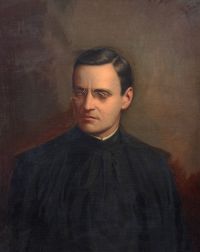
Portrait of Louise Imogen Guiney Louise Imogen Guiney Blessed Edmund Campion

In the spring of 1573, Campion found himself driven to a course he had not contemplated on coming to Douay. As he slowly saw his way, he followed it, to horizon beyond horizon. He had many steps to take, because in his thirst for perfection [58] he had far to travel. He told Dr. Allen he wished to leave his present life, go on pilgrimage, in the spirit of penance, to the Tomb of the Apostles at Rome, and there seek admission into the Society of Jesus. The mediæval Orders would have less attraction for Campion: he was an intensely “modern” man.
Source: Gutenberg

Saint Edmund Campion Ten Reasons Proposed to His Adversaries for Disputation in the Name

Though Blessed Edmund Campion's Decem Rationes has passed through forty-seven editions, [1] printed in all parts of Europe; though it has awakened the enthusiasm of thousands; though Mark Anthony Muret, one of the chief Catholic humanists of Campion's age, pronounced it to be "written by the finger of God," yet it is not an easy book for men of our generation to appreciate, and this precisely because it suited a bygone generation so exactly.
Source: Gutenberg

Get perspective with Kwize: daily news enlightened by great literature