Kiakhta

Definition and stakes

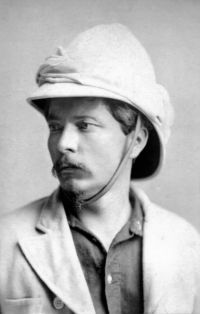
Portrait of Harry De Windt Harry De Windt,  From Pekin to Calais by Land

“ I have not exaggerated the state of things at Kiakhta, though must, in justice, add that it was the most dissolute and drunken place we came across. Some excuse, too, must be made for people living in a land with such squalid, depressing surroundings, and having absolutely no intellectual pursuits.
There are two roads from Kiakhta to Lake Baikal; one the old post-road, the other a private one, made and used by the tea-merchants, or by those having their permission. The latter is a hundred and eighty versts shorter than the old government post-road.
”
Source: Gutenberg

Portrait of Harry De Windt Harry De Windt,  From Pekin to Calais by Land

“ Kiakhta is a terrible place for bells. They were eternally going, morning, noon, and night——not a lively, cheery peal, but a slow, solemn tolling, like a continual passing-bell. But for this Troitzkosavsk is the sleepiest and most dead-alive town imaginable. Except, towards evening, when the population turn out en masse for a breath of fresh air, there is seldom a sound to break the dead silence that reigns in the unpaved, dusty street that constitutes its main thoroughfare, from morning till night. ”
Source: Gutenberg

Various,  Encyclopaedia Britannica, 11th Edition…

“ KIAKHTA, a town of Siberia, one of the chief centres of trade between Russia and China, on the Kiakhta, an affluent of the Selenga, and on an elevated plain surrounded by mountains, in the Russian government of Transbaikalia, 320 m. S.W. of Chita, the capital, and close to the Chinese frontier, in 50° 20′ N., 106° 40′ E. Besides the lower town or Kiakhta proper, the municipal jurisdiction comprises the fortified upper town of Troitskosavsk, about 2 m. N., and the settlement of Ust-Kiakhta, 10 m. farther distant. ”
Source: Gutenberg

Get perspective with Kwize: daily news enlightened by great literature