“ I said, "why should we fear, Lys?""Death should be welcome to those who love God," murmured Lys, and she drew the cross from her breast and kissed it."The moth might die if I threw it out into the storm," I said after a silence."Let it remain," sighed Lys.Late that night my wife lay sleeping, and I sat beside her bed and read in the Chronicle of Jacques Sorgue. I shaded the candle, but Lys grew restless, and finally I took the book down into the morning room, where the ashes of the fire rustled and whitened on the hearth. ”
Lys
Definition and stakes
The theme of “Lys” has been addressed by authors such as Robert William Chambers, H. B. Marriott Watson, George Wharton Edwards, Robert Dodsley and Guy Thorne. It is often associated with terms like Lysbeth, Lille, Lysia, love and Theos.
Quotes about “Lys”
“ When I returned to the morning room there was a driftwood fire on the hearth, and Lys sat in the chimney corner embroidering."Catherine tells me that the fishing fleet from Lorient is out. Do you think they are in danger, dear?" asked Lys, raising her blue eyes to mine as I entered."There is no wind, and there will be no sea," said I, looking out of the window. Far across the moor I could see the black cliffs looming in the mist."How it rains!" murmured Lys; "come to the fire, Dick." ”
 H. B. Marriott Watson,
A Romance at Random
(1910)
H. B. Marriott Watson,
A Romance at Random
(1910)
“ And one of the most important pieces of knowledge to gain, if you want to live with ease and without friction, concerns the appetites and tastes of men.” She spoke very slowly, as if she were thinking. She had sat down, and leaned her chin on her hand, her elbows on the table. She was not looking at de Lys, but abstractedly at the table-cloth or a plate. Her cloak had been laid aside, and she was in the full glory of evening dress. Half consciously de Lys glanced at his own rough lounging-suit, which was in evidence, now that he had thrown off his overcoat. ”
H. B. Marriott Watson,
A Romance at Random
(1910)
“ Sir Charles's voice burst out of his control. The card-players stared. An awkward silence fell on the room. “What can I get, sir?” asked de Lys cheerfully, breaking this. “I say, Winterbotham!” a man's voice issued from the card-table, where the second party were finishing. A fair, big bluff man came forward. “Look here, we're in the way,” he said in a lower voice. “I guess we'll go now.” De Lys slipped out of the room, leaving the master of the house a prey to bitter shame. He was not penitent, as he glanced down the hall toward the room in which the lady had entertained him. ”
George Wharton Edwards, Vanished towers and chimes of Flanders
“ La Lys flows over the level fields of our beautiful country, its fecund waters reflecting the blue of our wondrous Flemish landscape. Active and diligent servant, it seems to work ever to our advantage, multiplying in its charming sinuosities its power for contributing to our prosperity, accomplishing our tasks, and granting our needs. It gives to our lives ammunition and power. The noise of busy mills and the movement of bodies of workmen in its banks is sweet music in our ears, in tune to the rippling of its waters. ”
 Robert Dodsley,
A Select Collection of Old English Plays…
Robert Dodsley,
A Select Collection of Old English Plays…
“ Lys. Our causes are not equal. Eug. They will be, when you're dead. How you mistake [Pg 617] The laws of friendship, and commit those faults You did accuse me of! I would not live so long To think you can survive your dying friend. Lys. Eugenio, I am conquered; yet I hope thy kindness Will do that for me which thy sword refuseth. Love thy Hermione: she deserves it. Friend, Leave me alone awhile. Eug. Your grief's too great for me to trust your life with't: I dare not venture you beyond my help. Within. Where's Prince Lysicles? Where's Prince Lysicles? ”
H. B. Marriott Watson,
A Romance at Random
(1910)
“ De Lys saw him now in the light for what he was, a dull, unimaginative, and highly respectable man servant of fifty. “The lady, I say,” he said with some show of impatience. “I've tried to give her some whiskey, but she won't have it. Come along, man, do. It ain't a time to stare and gape.” ”
H. B. Marriott Watson,
The Foundlings
(1911)
“ Miss Lois laughed, and lifted her spoon. “Six,” she said with deliberate defiance. Jardine paid him even less attention. “I wish you’d go away, my dear fellow,” he said testily. “Looking over my hand always makes me nervous. And Miss Marjorie simply hates it, don’t you?” Miss Marjorie looked guiltily at de Lys, and then said loyally: “No, I don’t mind at all. Please, do I put this crossways?” “I suppose,” meditated de Lys aloud, “I suppose that I shall find Miss Delia in the card-room playing bridge with the others.” ”
H. B. Marriott Watson,
A Romance at Random
(1910)
“ De Lys grinned at him at the door of the room they had reached. “Why, at the suit of Bell and Weston, two hundred and thirty odd.” He entered, almost dragging in the butler as he spoke. “Here, my lady,” he called out in his suave, insinuating voice, such as bailiffs' men are wont to cultivate. “I've found one of your servants,” and to the butler in a lower but perfectly audible voice, “Make her take a little—go on, man. Otherwise she'll get hysterical! Don't mind me, my lady,” he called in a louder voice. “I can make myself at home. I've been too long a broker's man to cause any trouble. ”
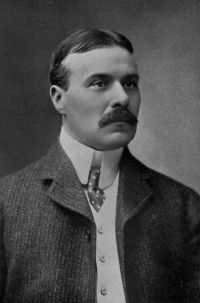
“ Mary Lys was a tall girl, dressed in the blue uniform of a hospital nurse. The cloak was thrown back over her shoulders, and its scarlet lining threw up the perfect oval contour of her face and the glorious masses of black hair that crowned it. If Marjorie Kirwan was generally said to be one of the prettiest girls in London—and the couple of millions she would inherit by no means detracted from her good looks—certainly Mary Lys might have been called one of the most beautiful. ”
 Robert William Chambers,
The Mystery of Choice
(1897)
Robert William Chambers,
The Mystery of Choice
(1897)
“ I walked into the dining room, beamed at the plates, walked out again; met Tregunc in the hallway, beamed on him; glanced into the kitchen, beamed at Catherine, and went up stairs, still beaming. Before I could knock at Lys's door it opened, and Lys came hastily out. When she saw me she gave a little cry of relief, and nestled close to my breast. "There is something peering in at my window," she said. "What!" I cried angrily. "A man, I think, disguised as a priest, and he has a mask on. He must have climbed up by the bay tree." ”
H. B. Marriott Watson,
No Trumps
(1910)
“ He gave a quick glance about the room, breathing somewhat heavily, as if from previous physical exertions. “Where's Miss Graham?” he turned on de Lys to ask abruptly. De Lys eyed him speculatively. The stranger was young and alert. He could not be a burglar, since he asked for Miss Graham. It occurred to de Lys that he might be one of Mr. Swainson's detectives. “It's no use,” he said, shaking his head. “The man has got away.” “Who has got away?” asked the young man. “The man you want,” replied de Lys, dallying with the situation easily. ”
H. B. Marriott Watson,
A Romance at Random
(1910)
“ She sat down, and gazed at the fire. “Unhappily our emotions are made for most of us; they are not the work of our own hands.” “'Lightly come, lightly go' is an admirable watchword,” he declared. “We should take it with us, and it will prove an excellent passport, giving us the freedom of our circumstances.” “Yes, men can and do,” she said bitterly. “Come,” said de Lys, moved to boldness by her attitude and the strangeness of the situation. “You yourself can rise to it—have risen. ”
 Lewis Morris,
Gycia: A Tragedy in Five Acts
Lewis Morris,
Gycia: A Tragedy in Five Acts
“ Lys. The lad is a good lad enough, but weak as water. The world always pardons successful enterprises. Besides, I am in great hopes that he has so quarrelled with the ruler of Cherson, and may be, moreover, so out of conceit with his wife, that we can do as we will with him.2nd Court. But be prudent, my Lord Lysimachus, I beg, for we know not how far he is with us, and if he is against us now, it may take more than we know to keep our heads on our shoulders.125Lys. My lords, you shall not lose a drop of your blood. But here is my Lord Asander. He looks cast down enough, in all conscience. ”
Robert William Chambers,
The Mystery of Choice
(1897)
“ Lys, active and graceful as a young deer, in spite of her Pont-Aven sabots, followed along the opposite bank until the fish settled in a deep pool, shook the line savagely once or twice, and then relapsed into the sulks. "Fight at the Groix Inn?" I called across the water. "What fight?" "Not exactly fight," quavered Lys, "but the Red Admiral has come out of his house at last, and he and my uncle are drinking together and disputing about butterflies. I never saw my uncle so angry, and the Red Admiral is sneering and grinning. Oh, it is almost wicked to see such a face!" ”
Arthur Weir, Fleurs De Lys, and Other Poems
“ He only is a poet who can find In sorrow happiness, in darkness light, Love everywhere; and lead his fellow-kind By flowery paths towards life's sunny height.TO WILLIAM AND ELIZABETH SOMERVILLE WEIR, HIS MOST SEVERE AND KINDLY CRITICS, THIS VOLUME IS LOVINGLY DEDICATED BY THEIR SON. PREFACE The name FLEURS DE LYS has been chosen for the Canadian Poems in the early portion of this book, because the scenes and incidents they describe belong to the Monarchial, or Fleur de Lys, period of France in Canada. The royal crest during the seventeenth century is depicted upon the cover. ”
Earl of Beaconsfield Benjamin Disraeli, Sybil, Or, The Two Nations
“ And very reluctant he was, I make no doubt, to sit next to Lady Maud. I wonder he does not fly higher, and preach to Lady Joan; but she is too sensible a woman for such fanatical tricks.” “St Lys thinks it his duty to enter all societies. That is the reason why he goes to Mowbray Castle, as well as to the squalid courts and cellars of the town. He takes care that those who are clad in purple and fine linen shall know the state of their neighbours. ”
 William Shakespeare,
Midsummer Night's Dream
(1918)
William Shakespeare,
Midsummer Night's Dream
(1918)
“ Made me compare with Hermia's sphery eyne? But who is here? Lysander! on the ground!100 Dead? or asleep? I see no blood, no wound. Lysander, if you live, good sir, awake. Lys. [Awaking.] And run through fire I will for thy sweet sake. Transparent Helena! Nature shows art,104 That through thy bosom makes me see thy heart. ”
Jessie L. Weston, Sir Gawain and the Lady of Lys (1907)
“ The king and his barons abode the fifteen days at the castle of Lys, nor departed therefrom; in all the world was neither fish nor fowl, fruit nor venison, of which the king might not each day eat in plenty if he so willed. But he was loth to part from Sir Bran de Lis, by reason of the good tales which he told concerning the folk of the Castle Orguellous, whereat the king rejoiced greatly. "Sire," quoth Bran de Lis, "I myself will go with ye, and we will take with us squires and footmen. My pavilion is large and fair, and by faith, we will carry that too along with us ”
 Edgar Rice Burroughs,
The Land That Time Forgot
Edgar Rice Burroughs,
The Land That Time Forgot
“ I was sure that Lys was dead. I wanted myself to die, and yet I clung to life—useless and hopeless and harrowing a thing as it had become. I clung to life because some ancient, reptilian forbear had clung to life and transmitted to me through the ages the most powerful motive that guided his minute brain—the motive of self-preservation. ”
H. B. Marriott Watson,
A Romance at Random
(1910)
“ And besides, the entire freedom you speak of does not amount to real liberty. Man is always conditioned by his affections, and—”It was she who interrupted now. “His affections!” She threw out her hands. “They derive from base metal. Oh, I have no patience with these affections of yours.” She rose and crossed the room. She seemed to listen by the door, and it was as if a great change had come over her. Watching her, de Lys had the feeling that something was impending; there was the atmosphere of a crisis in all the scene. ”
 Marie Corelli,
Ardath: The Story of a Dead Self
Marie Corelli,
Ardath: The Story of a Dead Self
“ Nay!—'tis a word for children and angels!—not for me! What have I to do with love? ... what hast thou? ... thou, Lysia, who dost make the lives of men thy sport and their torments thy mockery! There is no name for this fever that consumes me when I look upon thee, ... no name for this unquiet ravishment that draws me to thee in mingled bliss and agony! If I must perish of mine own bitter-sweet frenzy, let me be slain now and most utterly, ... but Love has no abiding-place 'twixt me and thee, Lysia! ”
 H. Rider Haggard,
Lysbeth, a Tale of the Dutch
H. Rider Haggard,
Lysbeth, a Tale of the Dutch
“ As Lysbeth skated down the canal towards the moat many of the good burghers of Leyden took off their caps to her, especially the young burghers, one or two of whom had hopes that she would choose them to be her cavalier for this day’s fete. Some of the elders, also, asked her if she would care to join their parties, thinking that, as she was an orphan without near male relations, she might be glad of their protection in times when it was wise for beautiful young women to be protected. ”
Marie Corelli,
Ardath: The Story of a Dead Self
“ Then Lysia, refilling the cup, kissed it again and handed it to Theos with so much soft animation and tenderness in her face as she turned to him, that his enforced calmness nearly gave way, and he had much ado to restrain himself from falling at her feet in a transport of passion, and crying out! ... "Love me, O thou sorceress-sovereign of beauty! ... love me, if only for an hour, and then let me die! ... for I shall have lived out all the joys of life in one embrace of thine!" ”
Thomas Godfrey, The Prince of Parthia: A Tragedy
“ Lysias. My Lord, forget her, tear her from your breast. Who, like the Phœnix gazes on the sun, And strives to soar up to the glorious blaze, Should never leave Ambition's brightest object, To turn, and view the beauties of a flow'r. Vardanes. O, Lysias, chide no more, for I have done. Yes, I'll forget this proud disdainful beauty; Hence, with vain love—Ambition, now, alone, Shall guide my actions, since mankind delights To give me pain, I'll study mischief too, And shake the earth, e'en like this raging tempest. Lysias. ”
Marie Corelli,
Ardath: The Story of a Dead Self
“ Here, on a couch of heaped-up, stemless roses, such as might have been prepared for the repose of Titania, Lysia seated herself, while Theos stood gazing at her in fascinated wonderment and gradually increasing masterfulness of passion. She looked lovelier than ever in that dim, soft, mingled light of rosy lamp and silver moonbeams,—her smile was no longer cold but warmly sweet,—her eyes had lost their mocking glitter, and swam in a soft languor that was strangely bewitching,—even the Orbed Symbol on her white bosom seemed for once to drowse. ”
Robert William Chambers,
The Mystery of Choice
(1897)
“ To be mayor in a village of nearly one hundred and fifty people! It was an empire! So he became unbearable, drinking himself viciously drunk every night of his life, maltreating his niece, Lys Trevec, like the barbarous old wretch that he was, and driving the Red Admiral nearly frantic with his eternal harping on the capture of Apatura Iris. Of course he refused to tell where he had caught the butterfly. The Red Admiral stalked his footsteps, but in vain. "He! he! he!" nagged the Purple Emperor, cuddling his chin over a glass of cider ”
H. Rider Haggard,
Lysbeth, a Tale of the Dutch
“ Then she slipped from the house and stole like a ghost through the darkling streets and out of the Maren or Sea Poort, where the guard let her pass thinking that she was a country woman returning to her village. Now the moon was rising, and by the light of it Lysbeth recognised the place. Here was the spot where she had stood on the day of the ice carnival, when that woman who was called Martha the Mare, and who said that she had known her father, had spoken to her. On that water she had galloped in Montalvo’s sledge, and up yonder canal the race was run. ”
Marie Corelli,
Ardath: The Story of a Dead Self
“ He, mute and oppressed by indistinct, hovering recollections, fed his gaze on her seductive fairness for one earnest moment longer,—then suddenly advancing he knelt before her, and took her unresisting hands in his."Lysia!"—and his voice, even to his own ears, had a solemn as well as passionate thrill,—"Lysia, what wouldst thou have with me? Speak! ... for my heart aches with a burden of dark memories,—memories conjured up by the wizard spell of thine eyes,—those eyes so cruel-sweet that seem to lure me to my soul's ruin! Tell me—have we not met before? ... loved before? ... ”
H. Rider Haggard,
Lysbeth, a Tale of the Dutch
“ Therefore Lysbeth uttered a sigh of joy when her husband appeared, followed only by a girl. “Wife,” he said, “here is our cousin, Elsa Brant, come to visit us from The Hague, though why I know not as yet. You remember Elsa, the little Elsa, with whom we used to play so many years ago.” “Yes, indeed,” answered Lysbeth, as she put her arms about her and embraced her, saying, “welcome, child, though,” she added, glancing at her, “you should no longer be called child who have grown into so fair a maid. ”
