“ That was all, but it was enough, for in a flash like lightning, the past and present and future were transformed for Niels Lyhne by the consciousness that he loved the woman standing by his side, not as anything bright and sweet and happy and beautiful that would lift him to ecstasy or rapture—such was not the nature of his love—but he loved her as something he could no more do without than the breath of life itself, and he reached out, as a drowning man clutches, and pressed her hand to his heart. ”
Niels Lyhne
Definition and stakes
The theme of “Niels Lyhne” has been addressed by authors such as J. P. Jacobsen, Knut Hamsun, Various and Edmund William Gosse. It is often associated with terms like Lynne, West, Mr., Erik and Carlyle.
Quotes about “Niels Lyhne”
“ To the student of Jens Peter Jacobsen’s life and works, Niels Lyhne has a value apart from its greatness as literature from the fact that it is the book in which the author recorded his own spiritual struggles and embodied the faith on which he came, finally, to rest his soul in death as in life. It tells of his early dreams and ideals, his efforts to know and to achieve, his revolt against the dream-swathed dogmas in which people take refuge from harsh reality, and his brave acceptance of what he conceived to be the truth, however dreary and bitter. ”
“ On the second day in the hospital, Niels felt more and more oppressed by the heavy atmosphere in the room, and his longing for fresh air was strangely intertwined in his mind with the desire to live. After all, there had been so much in life that was beautiful, he thought, as he remembered the fresh breeze along the shore at home, the cool soughing of the wind in the beech forests of Sjaelland, the pure mountain air of Clarens, and the evening zephyrs of Lake Garda. But when he began to think of human beings, his soul sickened again. ”
“ So widely different, then, were Niels Lyhne’s father and mother, the two friendly powers that struggled unconsciously for mastery over his young soul from the moment the first gleam of intelligence in him gave them something to work on. As the child grew older, the struggle became more intense and was waged with a greater variety of weapons. ”
“ Jacobsen’s own youthful ideal speaking through Niels Lyhne’s mouth when he says: “Mother—I am a poet—really—through my whole soul. Don’t imagine it’s childish dreams or dreams fed by vanity.... I shall be one of those who fight for the greatest, and I promise you that I shall not fail, that I shall always be faithful to you and to my gift. Nothing but the best shall be good enough. No compromise, mother! When I weigh what I’ve done and feel that it isn’t sterling, or when I hear that it’s got a crack or a flaw—into the melting-pot it goes! Every single work must be my best!” ”
“ All the memories of my girlhood you have poisoned. What have I to look back on that is clean and good now! You have tainted everything. It is not only he that is dead, everything bright and good that has been between us is dead, too, and rotten. Oh, God help me, is it fair that I can’t get any revenge on you after all you have done? Make me honest again, Niels Lyhne, make me pure and good again! ”
“ What she gave Niels Lyhne to see was very encouraging, and they had not been alone for many days in the magnificent hotel garden with its pomegranates and myrtles, with its arbors of blossoming nerias and its marvellous view, before they were on very friendly terms. [254] They were not at all in love with each other, or if they were, it was not very serious. It was one of the vague, pleasant intimacies that will sometimes grow up between men and women who are past the time of early youth when nature flames up and yearns toward an unknown bliss. ”
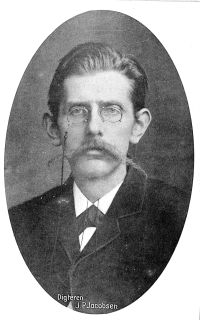
“ The person of the hero is marked for a self-portrait by the description, “Niels Lyhne of Lönborggaard, who was twenty-three years old, walked with a slight stoop, had beautiful hands and small ears, and was a little timid,”—though friends of Jacobsen’s youth declare that “a little timid” was far from describing the excessive shyness from which he suffered. He himself would sometimes joke about his “North Cimbrian heaviness,” for like Niels Lyhne he was a native of Jutland, where the people are more sluggish than the sprightly islanders. ”
“ Niels Lyhne was bent upon being a poet, and there was much in the external circumstances of his life to lead his thoughts in that direction and stimulate his faculties for the task. So far, however, he [107] had little but his dreams to write about, and nowhere is there more sameness and monotony than in the world of imagination; for in that dreamland, which seems so boundless and so infinitely varied, there are, in fact, only a few short beaten paths where everybody walks and from which no one ever strays. People may differ, but in their dreams they do not differ ”
“ The individuality that can be lost in the sifting and reshaping of a healthy development is only a flaw; it is a branch grown in the dark, which is distinctive only so long as it retains its sickly pallor. And it is by the sound growth in yourself that you must live. Only the sound can grow great. [150] Christmas Eve came upon Niels Lyhne unawares. For the past six months, he had not visited any one except now and then the Neergaards. They had invited him to spend the evening with them, but last Christmas Eve had been the memorable one at Clarens, and therefore he preferred to be alone. ”
“ From that day Niels felt a timid happiness in Edele’s presence. She was no more a human being like any one else, but an exalted creature, divine by virtue of her strange, mystic beauty. His heart throbbed with rapture in merely looking at her, kneeling to her in his heart, crawling to her feet in abject self-effacement. Yet there were moments when his adoration had to have vent in outward signs of subjection. ”
“ No home on earth, no God in heaven, no goal out there in the future! He would at least have a home. He would make it his own by loving everything there, big and little, every rock, every tree, the animate and the inanimate; he would portion out his heart to it all so that it could never cast him off any more. [258] Chapter XIII For about a year, Niels Lyhne had lived at Lönborggaard, managing the farm as well as he knew how and as much as his old steward would let him. He had taken down his shield, blotted out his ’scutcheon, and resigned. Humanity would have to get along without him ”
“ In his strictures on dreams and dreamers Jacobsen scourged his own sluggish temperament, and the story of Niels Lyhne’s futile efforts is in part the record of the author’s own youth. From the time he was ten years old, he tells us, his one sure dogma was that he was to be a poet, and there must have been years of his boyhood and early manhood when he was haunted by visions of what he wanted to write without being able to frame it in a form satisfactory to himself. ”
“ Niels was quite a lad now, twelve years old, nearing thirteen, and he no longer needed to hack thistles and burdocks in order to feed his knightly fancies, any more than he had to launch his explorer’s dreams in a mussel-shell. A book and a corner of the sofa were enough for him now, and if the book refused to bear him to the coast of his desires, he would hunt up Frithjof and tell him the tale which the book would not yield. Arm in arm, they would saunter down the road, one telling, both listening ”
“ A most superbly delicate delineation of the feminine soul is here given in the drawing of Hanka and Aagot; nowhere else is woman's love in its dawn and growth described with such mastery, with a deftness and sureness of touch which reminds one of the very greatest passages in that Danish classic, 'Niels Lyhne.'"Hamsun is now in his fifty-fourth year. The expectations aroused by his first book have been more than fulfilled; the star that was born overnight still shines with undimmed brilliance—nay, with a purer, warmer, steadier flame. ”
“ Toward morning Erik came home, and when Fennimore saw him by the cold, truthful light of dawn, preparing to go to bed, heavy and unsteady with drink, his eyes glazed from gambling and his face dirty-pale after the sleepless night, then all the fair words Niels had spoken seemed to her [221] quite visionary. The bright promises she had made to her own heart fainted and paled before the oncoming day—vapory dreams and fumes of fancy: a fairy flock of lies! ”
“ The youngest had formed three or four of them into rings wound about with red bark, and had put them on her head like a turban.It was she who was speaking.“She says he looks like Themistocles on the stove in the study,” she remarked to her fellow conspirators, and turned up her eyes with a rapt expression. [262] “Oh, pshaw,” said the middle one, a saucy little lady who had just been confirmed that spring; “do you suppose Themistocles was round-shouldered?” She imitated Niels Lyhne’s slight stoop. “Themistocles! Not much!”“There is something so manly in his look; he is a real man!” ”
“ Yes, Miss Lyhne, I am only a poor servant in your brother’s house, and yet there is a world where I am ruler, powerful, proud, rich, with the crown of victory, noble by virtue of the passion that drove Prometheus to steal the fire from the heaven of the gods. There I am brother to all the great in spirit, whom the earth has borne, and who bear the earth. I understand them as none but equals understand one another; no flight that they have flown is too high for the strength of my wings. ”
“ He was Aladdin, and there was not a thing he had been storming the clouds for but it had fallen right down into his turban.Now came a happy time for Niels, the glorious time when the mighty impulse of growth sweeps us jubilantly past the dead points in our own nature; when we are filled to bursting with a strength that makes us eager to put our shoulders to mountains if need be, while we build away bravely on the Tower of Babel, which is meant to pierce the sky, but ends in being just a squatty structure that we go on all our lives adding to—now a timid spire, now a freakish bay window. ”
“ Niels had travelled two hundred miles to bring aid, and here he sat feeling his impulse put to shame, while the colder side of his nature looked on. For what could he do, when it came to the point? What if he tried to talk picturesquely to Erik, in many words of purple and [207] ultramarine, dripping with light and wading in shadow! There had been a dream of something like that in his brain when he started out. How utterly absurd! To bring aid! You might perhaps drive away the goddess with the closed hands from an artist’s door, but that was certainly the utmost ”
“ As the autumn advanced, Erik’s drinking-bouts became more frequent. What was the use, he said to Niels, of sitting at home waiting for ideas that never came, until his thoughts turned to stone in his head? Moreover, he did not get much comfort from Niels’s society; he needed people with some grit in them, people of lusty flesh and blood, not a whim-wham of delicate nerves. Niels and Fennimore were therefore left much alone, for Niels came over to Marianelund every day. ”
J. P. Jacobsen,
Marie Grubbe, a Lady of the Seventeenth Century
“ It expresses Jacobsen’s struggle, not only against the bodily weakness that laid its paralyzing hand on his faculties, but also against the sluggish, dreamy blood he had inherited, which made all creative work an agonizing effort. [3] Illustreret Dansk Litteraturhistorie.Niels Lyhne is an outsider from life. He seems never to fill any particular place in his world. He has a poetic gift and high artistic ideals, but never writes. Two women leave him for other men less fine and lovable. ”
“ Three were company, variety, change; two were boredom and nothing at all.What in the world could two find to do?Could two shoot at a target or two play ball? They could play Friday and Robinson Crusoe, to be sure, but then who would be the savages?Such Sundays! Niels was so weary of existence that he began first to review and afterwards, with the aid of Mr. Bigum’s large atlas, to extend his geographical knowledge far beyond the prescribed bounds. Finally, he started to read the whole Bible through and to keep a diary. ”
“ Whatever stamped itself on Niels’s mind, what he saw, what he understood and what he misunderstood, what he admired and what he knew he ought to admire—all was woven into the story. As running water is colored by every passing picture, sometimes holding the image with perfect clearness, sometimes distorting it or throwing it back in wavering, uncertain lines, then again drowning it completely in the color and play of its own ripples, so the lad’s story reflected feelings and thoughts, his own and those of other people, mirrored human beings and events, life and books, as well as it could. ”
“ She felt herself growing pale with rapture. Softly she laid both hands on her son’s head, but he drew them gently to his lips and kissed them.“You have made me so happy, Niels! Then my life has not been one long, useless sigh, if I have helped to lead you on as I hoped and dreamed so ardently—good heavens! how often I have dreamed it!—And yet there is so much sadness mixed in my joy, Niels! To think that my fondest wish should be fulfilled, the thing I have longed for so many years.... Such things happen only when life is almost done.” ”
“ They take out all their store of pretty secrets, all the exquisite useless trifles people accumulate like bric-à-brac of the soul, pass them from hand to hand, turn them round and hold them up, seeking the most artistic light-effect, comparing and analyzing.It is, of course, only when life passes in a leisurely way that such Sunday friendships are possible, and here by the quiet lake these two had plenty of time. Niels had made a beginning by draping Madame Odéro in a becoming robe of melancholy. ”
“ First the despair, the bootless despair, and then the merciful stupor—that must be the explanation. It seemed to Niels that he understood everything: the hardness in her, the dreary humility, and her coarseness, which was the bitterest drop in the whole goblet. By degrees he came to see also that his delicacy and deferential homage must oppress and irritate her, because a woman who has been hurled from the purple couch of her dreams to the pavement below will quickly resent any attempt to spread carpets over the stones which she longs to feel in all their hardness. ”
“ There was such quiet over the fjord that the sound of the oars seemed only to measure the stillness in pauses of equal length. Hushed and soft, the gray twilight brooded over the soundless deep; the boat and its occupants melted together in one dark mass, from which the phosphorescence freed the plying oars and sometimes a trailing rope’s end, or perhaps the brown impassive face of the oarsman. No one spoke. Fennimore was cooling her hand in the water; she and Erik sat turning back to look at the network of light that trailed silently after the boat and held their thoughts in its fair meshes. ”
“ For that reason Niels and Frithjof were afraid of him. They formed themselves after him, denied much and concealed more. Niels was especially quick to suppress in himself anything that was not of Erik’s world, and with the burning zeal of the renegade, he scoffed at Frithjof, whose slower, more faithful nature could not instantly throw over the old for the new. His unkind mockery really sprang from jealousy, for he had fallen in love with Erik on the very first day, while the latter, in shy aloofness, half reluctant, half supercilious, just barely and grudgingly allowed himself to be loved. ”
