“ The Swiss Alps have their chief worshippers in the summer for the climbing, in the winter for the sports. A few insist that the rich colouring of autumn is the best season of all. A larger and a growing number visit the Alps in the spring for the flowers. They are wise, for truly the sight of an Alpine meadow in bloom is the most joyous manifestation of Nature in a sunny mood that man can know. ”
Swiss Alps
Definition and stakes
Quotes about “Swiss Alps”
Fredrika Bremer,
Life in the Old World
(1860)
“ We were soon, all of us, either on horse or on foot, clambering up Riffelberg,—now under the leadership of Ignace Biner, the best guide in this Alpine region. And ever, as we climb, we behold the Alp-horizon become more extensive; one ice-peak after another rises up, and immense ice-fields spread out their white, shining table-cloths, between them, until the whole northern chain of Swiss Alps stands in a vast semicircle around the horizon. We halt upon gum plains on the mountain, to contemplate the glorious spectacle, whilst we rest in the sunshine. ”
Douglas William Freshfield,
Italian Alps
“ For ladies, botanists, and quiet strollers there is an unusual abundance of easy walks, through shady glades full of rare and beautiful flowers and ferns, by the side of clear dove-coloured brooks glancing down over the limestone shelves, or up to secluded tarns and grassy ridges whence the great horns and teeth glow orange against the sky, or the Adamello snows glitter in the sunlight. Moreover, active climbers have within easy reach a variety of glacier-work which all but two or three of the greatest Swiss centres might envy, and rock scenery such as Switzerland can nowhere rival. ”
“ The funicular railways are ruining the whole of the Swiss Alps; the greed of a few speculators and the irreverent folly of the multitude combine to scar the sides of the great mountains and gather on their summits troops of gaping sightseers, to whom the solemnity of the Gletsch Alp or the virginity of the Jungfrau are of no account. ”
Douglas William Freshfield,
Italian Alps
“ If he wishes to paint the central snowy range as portions of the landscape rather than to study them for themselves, he should begin with the further side of the Alps. There, even in the clear summer weather, when the Swiss crags seem most hard and near, and the pine-trees crude and stiff, all the hollows of the hills are filled with waves of iridescent air, as if a rainbow had been diffused through the sky. The distances, purple and blue, float before the eye with a soft outline like that of the young horns of a stag. Even the snows are never a cold white ”
Robert Caldwell Reid, Rambles on the Golden Coast of New Zealand (1886)
“ Writing of his trip from Christchurch to Hokitika, he says:—“The Alps in the Middle Island, 400 miles in length, resemble the Swiss Alps only in name, as their slopes are clothed with luxuriant vegetation, often to the snow level, and their shapes have a picturesqueness and individuality of their own, owing to their crystalline formation as against the great conglomerate beds of the Miocene formation of portions of the Swiss Alps. ”
Douglas William Freshfield,
Italian Alps
“ Better acquaintance has led to the discovery of all the beauties and benefits the Alps offer to those who seek them in a proper mood. We have learnt thoroughly to appreciate the variety imparted to all nature by the accidents of hill scenery, to know and love the thousand forms of peaks, the changing charm of lakes and forests, the rush of the grey Swiss torrent under the upright pines, and the blue repose of the Italian stream under the beech shadows. ”
Elizabeth Cabot Cary Agassiz,
A Journey in Brazil
“ As I stood there, panoramas from the Swiss mountains came up to my memory, and I fancied myself on the Alps, looking across the plain of Switzerland instead of the bed of the Amazons; the distant line of the Santarem hills on the southern bank of the river, and lower than the northern chain, representing the Jura range. As if to complete the comparison, Alpine lichens were growing among the cacti and palms, and a crust of Arctic cryptogamous growth covered rocks, between which sprang tropical flowers. ”
Various, The Atlantic Monthly, Volume 15…
“ The scarlet and white of their dresses, catching the sunshine, make the few high notes that cause the whole piece to throb like music.There is also a large Swiss landscape, possessing in an extraordinary degree the pure, keen atmosphere, as well as the grand mountain forms, of the Alpine spaces. To look on this piece exhilarates as does the sight of the Alps themselves; and it strikes the [Pg 131] eye as a shrill trumpet sound the ear. This landscape, a grand antithesis to the last described, marks a great range of power in the mind that produced them both. ”
Boyd Winchester,
The Swiss Republic
(1891)
“ Then come the Finsteraarhorn and Monte Rosa, being, next after Mont Blanc, the two highest mountains in Europe. The most important ranges are the Alps, which run along the Italian frontier, the Bernese Oberland, and the Juras, which separate Switzerland on the west from France. Of the Bernese Alps the Finsteraarhorn, Jungfrau, Eiger, and Schreckhorn are the most conspicuous. As to height, the Alps are divided into the High Alps, rising from eight thousand to fifteen thousand feet above the level of the sea, and covered with perpetual snow and ice ”
Walter Besant,
Armorel of Lyonesse: A Romance of To-day
“ Most Swiss people seem to care nothing for their Alps, but here and there is one who would gladly spend all his days high up among the fragrant pines, or climbing the slope of ice with steady step and slow. ”
William Wordsworth,
The Prose Works of William Wordsworth
“ Hence, on the score even of sublimity, the superiority of the Alps is by no means so great as might hastily be inferred;—and, as to the beauty of the lower regions of the Swiss Mountains, it is noticeable—that, as they are all regularly mown, their surface has nothing of that mellow tone and variety of hues by which mountain turf, that is never touched by the scythe, is distinguished. ”
Sir Charles Lyell,
The Student's Elements of Geology
“ The nummulitic limestone of the Swiss Alps rises to more than 10,000 feet above the level of the sea, and attains here and in other mountain chains a thickness of several thousand feet. It may be said to play a far more conspicuous part than any other tertiary group in the solid framework of the earth’s crust, whether in Europe, Asia, or Africa. ”
George H. Heffner, The Youthful Wanderer
“ When fall comes, all the landlords must take their families and move down from the mountain, as it would be impossible to keep the track of the railroad clear during the winter to bring up the necessary provisions for them. The snow is often from 10 to 20 feet deep on these Alps.All Swiss scenery, whether one is on the lakes, upon the mountains, or in the valleys and ravines, is singularly charming, and bears no resemblance to the scenery which one sees elsewhere ”
William Elliot Griffis,
Swiss Fairy Tales
(1920)
“ It may happen, in Switzerland, that mighty masses of snow and ice, sometimes as big as the capitol at Washington, and as high as Bunker Hill monument, will roll down the mountain sides without giving any notice. These crush whole forests, bury villages, tear rocks to pieces, knock off bits of the mountain sides and kill thousands of people, cows, goats and horses. Though large enough to engulf an army, or a battleship, they are very small, when first born, up in the very high Alps. Starting as a snow ball, they grow large, very quickly, every moment, and finally become immense. ”
William Augustus Brevoort Coolidge, 1911 Encyclopædia Britannica (1911)
“ The main chain of the Alps rises in Swiss territory to the height of 15,217 ft. in the loftiest summit or Dufourspitze (wholly Swiss) of Monte Rosa, though the Dom (14,942 ft.) , in the Mischabel range, between Zermatt and Saas, is the highest mountain mass which is entirely Swiss. The great northern outher attains a height of 14,026 ft. in the Finsteraarhorn (Bernese Oberland) , while the lowest level (581 ft.) within the Confederation, is on the Lago Maggiore. The highest permanently inhabited village in Switzerland is Juf (6998 ft.) ”
“ He courts the heat of the sun and the monotony of French plains—their sluggish streams, and never-ending poplar trees—for the sake of the evening coolness and the gradual approach to the great Alps, which await him at the close of the day. It is about Mulhausen that he begins to feel a change in the landscape. The fields broaden into rolling downs, watered by clear and running streams; the great Swiss thistle grows by riverside and cowshed; pines begin to tuft the slopes of gently rising hills ”
F. F. Roget, Ski-runs in the High Alps
“ Snobbery is seen in its true proportion against a background of mountains. The wealth of enthusiasm which mountaineering inspires among the artisan classes of Switzerland is a permanent asset to the nation, lifting all those who come into contact with the hills out of their narrow ambitions. Shelley felt this truth. The great peaks, he writes, have a voice to repeal large codes of fraud and woe. One had only to look at these Swiss to feel how their lives were coloured, their ideals raised, their views broadened, by their love of their native mountains. ”
“ But the Grund-Lawine is really the most beneficial avalanche of the Alps, doing quickly the work, which a glacier does slowly, of carrying down soil from the heights to the plains. It is rare in the Swiss Alps, more common in mountains of younger age going through earlier processes of disintegration. Perhaps, if one is to look at an avalanche chiefly as an instrument of death, the Grund-Lawine has a greater objectionableness than the Staub-Lawine. ”
Louis Pope Gratacap,
Popular Science Monthly
(1877)
“ These have come from the Alps; they are crystalline rocks, gneiss, and granite, and they lie upon ridges of limestone. They are virtually nothing less than dislocated fragments of those abraded and decreasing hills perched upon the Jura cliffs. Prof. Guyot has placed, beyond all doubt, their home upon the summits and sides of the Swiss Alps, and shown that they have attained their present eminence by a positive carriage from these original localities. ”
Boyd Winchester,
The Swiss Republic
(1891)
“ Geologists think that the glaciers of the present day are “mere pigmies as compared to the giants of the glacial epoch;” and that their action has had much to do with the architecture of the Alps; that the ice exerts a crushing force on every point of its bed which bears its weight, and the glaciers would naturally scoop out and carve the mountains and valleys into the slopes which we now see; and that the plains of Italy and Switzerland are covered with débris of the Alps. These geologists are pretty well agreed that the Lake of Geneva was excavated by a glacier. ”
Blanche Willis Howard,
One Year Abroad
“ You depart impressed with the magnitude of the Falls of the Rhine, and quite conscious of a not insignificant fall of francs in your purse. DOWN FROM THE HIGH ALPS. It is not wise to visit what are called the High Alps first and then make the tour of the Swiss cities. This order should be reversed. From loveliness we should ascend to grandeur, and not come down from Engadine heights, and space and air, to cities, pretty lakes, purplish hills, and white peaks in the background. ”
William Elliot Griffis,
Swiss Fairy Tales
(1920)
“ How the Swiss people first received the Alpine horn, as a gift from the fairies, is told in the story of a faithful shepherd’s boy, named Perrod. He had to work hard all day, in tending the cows that grazed on the high mountain pastures, which the natives call the Alps. But when foreign people speak of “the Alps,” they mean the ranges of mountains themselves. In winter, these level stretches of ground are covered with snow and ice, but by the month of June, it is warm enough for the grass and flowers to grow. Then the cowboys and cheese makers go up with their cattle. ”
Mary Wollstonecraft Shelley, Rambles in Germany and Italy in 1840… (1844)
“ We still continued along the valley of the Rhine, and at length entered the pass of the Via Mala, where we alighted to walk. It is here that the giant wall of the Alps shuts out the Swiss from Italy. Before the Alp itself (the Splugen) is reached, another huge mountain rises to divide the countries. A few years ago, there was no path except across this mountain, which being very exposed, and difficult even to danger, the Splugen was only traversed by shepherds and travellers of the country on mules or on foot. ”
Wladislaw Somerville Lach-Szyrma, Aleriel (1886)
“ The nearest thing I can liken it to on earth is the view of the Alps from some of the Swiss mountains. I have seen something a little like it when I rested once on the summit of Jungfrau, and looked upon the chains of Alpine peaks,–on Eiger, the Wetterhorn, and far-off Mont Blanc. ”
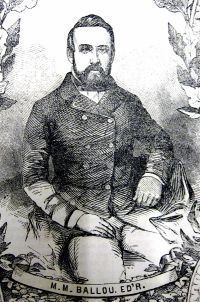
Maturin M. Ballou,
Due North; or, Glimpses of Scandinavia and Russia
“ Persons who explore these glaciers wear spiked shoes as a necessary precaution, and to aid them in creeping along the slippery, rubbled surface of the ice. With a proper guide and reasonable care, however, there is little danger to be apprehended, or at least no more than is encountered by climbers among the Swiss Alps. These glaciers, as we have shown, are not confined to the mountain regions and elevated plateaus, but extend gradually downward in their lower portions very near to the shore, where vegetation in strong contrast thrives close to their borders. ”
Louis Agassiz,
Louis Agassiz: His Life and Correspondence
“ One thing gives me great pleasure: from one of my windows the whole chain of the Tyrolean Alps is visible as far as Appenzell; and as the country is flat to their very base, I see them better than we see our Alps from the plain. It is a great pleasure to have at least a part of our Swiss mountains always in sight. ”
Boyd Winchester,
The Swiss Republic
(1891)
“ Mountains rise on every side, groups of the Alps of Savoy, Valais, and Jura. The northern or the Swiss shore is chiefly what is known as a côte, or a declivity that admits of cultivation, with spots of verdant pasture scattered at its feet and sometimes on its breast, with a cheery range of garden, chalet, wood, and spire; villas, hamlets, and villages seem to touch each other down by the banks, and to form but one town, whilst higher up, they peep out from among the vineyards or nestle under the shade of walnut-trees. ”
Sir William Martin Conway, The Alps
“ Truly, however, the whole of a pass is the route through a mountain region from plain to plain. Few mountaineers nowadays ever cross a range in that way except by train, and yet it is one of the most delightful experiences. Motor-cars will enable us to enjoy such traverses by road, when the Swiss have learnt the wisdom of granting free passage across the Alps to any kind of [199] vehicle. It is only when a range of mountains is approached from the plain that its mass and geographical value as a dividing wall can be felt. ”
F. F. Roget, Ski-runs in the High Alps
“ Little more than ten years have elapsed since men with a knowledge of summer mountaineering began to explore the Alps in winter. Not only are the successes, which have almost invariably attended the winter exploration of the Swiss ice-fields, full of instruction for the novice, but also the accidents and misfortunes which, sad to say, ended in loss of life or limb, have conveyed useful lessons. ”
Sir John Lubbock,
The Beauties of Nature, and the Wonders of the World We Live In
“ If the centre of force were along the axis of elevation, the result would, as Suess and Heim have pointed out, be to extend, not to compress, the strata; and the folds would remain quite unaccounted for. The suggestion of compression is on the contrary consistent with the main features of Swiss geography. The principal axis follows a curved line from the Maritime Alps towards the north-east by Mont Blanc and Monte Rosa and St. Gotthard to the mountains overlooking the Engadine. The geological strata follow the same direction. ”
Clive Holland, Tyrol and Its People
“ Summits, the ascent of which a few years ago was looked upon as a great achievement by even good climbers, are now scaled by numbers of people every year; and each year brings additions to the conquered peaks, some of which were a decade ago looked upon as absolutely unclimbable, and likely to remain so.The Dolomites are, indeed, gradually becoming as well known to climbers and would-be climbers of even the countries of Western Europe as are the Swiss Alps, and annually a larger number of lovers of Alpine scenery take their holidays in this region ”