“ The body is elevated, the throat swells, the eyes sparkle. He continues his notes, and now and then rises on the wing, and flies a few yards to approach the fugitive and timorous female. Like the domestic pigeon and other species, they caress each other by billing, in which action, the bill of the one is introduced transversely into that of the other, and both parties alternately disgorge the contents of their crops by repeated efforts. These preliminary affairs are soon settled, and the pigeons commence their nests in general peace and harmony. ”
Domestic pigeon
Definition and stakes
Quotes about “domestic pigeon”
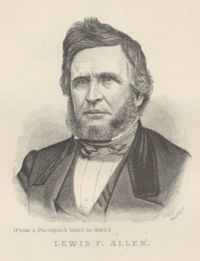
Lewis Falley Allen,
Rural Architecture
“ But there are many fancy breeds—such as the fan-tail, the powter, the tumbler, the ruffler, and perhaps another variety or two—all pretty birds, and each distinct in their appearance, and in some of their domestic habits. The most beautiful of the pigeon kind, however, is the Carrier. They are the very perfection of grace, and symmetry, and beauty. Their colors are always brilliant and changing, and in their flight they cleave the air with a rapidity which no other variety—indeed, which scarce any other bird, of any kind, can equal. ”
John H. Robinson, Our Domestic Birds: Elementary Lessons in Aviculture
“ Place in domestication. Although many farmers keep small flocks of pigeons, the pigeon in modern times is a city bird rather than a country bird. The strong flying types are all well adapted to an independent life in towns and cities, where, as has been stated, they often become a nuisance. This form of nuisance might be partly abated and perhaps prevented if city authorities would systematically and humanely exterminate the free flocks of common pigeons, and encourage citizens to breed improved varieties under proper control. ”
“ A person told me that he once rode furiously into one of these rolling multitudes and picked up thirteen pigeons which had been trampled to death by his horse's feet. In a few minutes they will [22] beat the whole nuts from a tree with their wings, while all is a scramble, both above and below, for the same. They have the same cooing notes common to domestic pigeons, but much less of their gesticulations. In some flocks you will find nothing but young ones, which are easily distinguishable by their motley dress. ”
The Circle of Knowledge: A Classified…
“ The most important of the domestic pigeons are the common pigeon, the trumpeter, the ruff pigeon, the Jacobin, the Turkish pigeon, the carrier pigeon, which, on account of its great power of remembering localities, is used for carrying messages; the pouter, the tumbler, the turbit, the fantail, and the oriental pigeon. The young pigeons are highly esteemed for their delicate flavor. ”
Claude Harris Miller, Outdoor Sports and Games
“ Almost every one who starts keeping domestic pets either soon tires of the sport or becomes a fancier. The care of common pigeons is a very simple matter. The principal thing is a good loft or cote for them in the top of a barn or house. They will practically take care of themselves and after a few years greatly increase in numbers.A model pigeon house for breeding fancy pigeons requires separate mating boxes, nests and other appliances. It would be impossible to make much of a success with fancy pigeons if they are allowed their liberty to fly about and mate at will. ”
“ The breeding of the wild pigeons, and the places chosen for that purpose, are points of great interest. The time is not much influenced by season, and the place selected is where food is most plentiful and most attainable, and always at a convenient distance from water. Forest trees of great height are those in which the pigeons form their nests. Thither the countless myriads resort, and prepare to fulfill one of the great laws of nature. At this period the note of the pigeon is a soft coo-coo-coo-coo much shorter than that of the domestic species. ”
John H. Robinson, Our Domestic Birds: Elementary Lessons in Aviculture
“ The pigeon has the power of disgorging the contents of the crop at will, and feeds its young by forcing food from its crop into their mouths. When they are well fed, the squabs grow very fast. Young Homers four weeks old often weigh from three quarters of a pound to a pound, or even more, and are ready for market. Many of the fancy varieties of pigeons are hard to rear, because the abnormal structure of the beak or the interference of peculiar feather characters prevent the old ones from feeding their young properly. ”
John H. Robinson, Our Domestic Birds: Elementary Lessons in Aviculture
“ Pigeon culture does not afford as many or as good opportunities for profit as poultry culture does, but it is suited to conditions under which poultry do not thrive. A flock of pigeons may be permanently maintained by a city resident who has so little room for domestic birds that, if he kept poultry, he would have to renew his flock every year. A few pigeons may be kept by any one who can provide a nesting place for them where they will be safe from cats and rats. ”
John H. Robinson, Our Domestic Birds: Elementary Lessons in Aviculture
“ Handling pigeons. When a few pigeons in a small loft get a great deal of attention, they usually become very tame and allow themselves to be caught at any time. For catching pigeons that are shy, pigeon keepers use a net, called a landing net, such as is used by fishermen. A pigeon is held securely in the hand by grasping it so that the breast of the bird lies in the palm and one wing is held against the side by the thumb and the other by the fingers. A pigeon may also be carried by the tips of the wings by bringing them together over the back and letting the bird hang by them. ”
John H. Robinson, Our Domestic Birds: Elementary Lessons in Aviculture
“ The breeding of fancy pigeons is also almost wholly a spare-time occupation. The demand for fancy pigeons is small in comparison with the demand for fancy poultry, and a pigeon fancier's trade rarely grows so large that he can give his attention to it exclusively. In Europe the breeding of pigeons for exhibition and sport is more popular than in America, but the interest is growing rapidly in this country. ”
John H. Robinson, Our Domestic Birds: Elementary Lessons in Aviculture
“ The furnishings of the pigeon loft are different from those of the poultry house, and of course the fly is always completely inclosed. Upper floors or lofts of buildings are used for pigeons to much better advantage than for poultry, but where there is room it is more satisfactory to have all quarters for pigeons on the ground floor.As the young pigeons remain in the nest and are fed by the parents until they are almost full-grown, each pair of old pigeons must have their own nesting place. ”
J. G. Wood, Story of the Bible Animals
“ The practice of pigeon-keeping has survived to the present day, the houses of wealthy men being furnished with separate pigeon-houses for the protection and shelter of these popular birds.In the Holy Land are found all the species of Pigeons with which we are familiar, together with one or two others. First, there is the Rock Pigeon, or Blue Rock Dove, which is acknowledged to be the origin of our domestic breeds of Pigeons, with all their infinite variety of colour and plumage. ”
John H. Robinson, Our Domestic Birds: Elementary Lessons in Aviculture
“ Where the space for pigeons is very limited and there is room for only one small loft and fly, breeding operations are closely restricted. Most pigeon fanciers want at least two lofts of this size—one for the breeding birds, the other for the young birds that no longer need the care of their parents. With such facilities the work in the breeding loft goes on better, and promising young birds can be kept until they are well matured and the breeder can tell whether it is advisable to keep some of these and dispose of a part of the old ones. ”
Jean-Henri Fabre,
Our Humble Helpers: Familiar Talks on the Domestic Animals
(1918)
“ These few examples show you sufficiently what diversity pigeon-house life has stamped on the form, habits, and plumage of the primitive bird. “All pigeons, wild as well as tame, lay never more than two eggs to a hatching, from which generally spring brother and sister. The cares of brooding [145] are shared by the father and mother alike, a practice found in no other tame bird. In the morning, when hunger makes itself felt, the female calls the male by a peculiar cooing and invites him to come and take her place on the eggs, which he does with alacrity. ”
John H. Robinson, Our Domestic Birds: Elementary Lessons in Aviculture
“ One of the most attractive pigeons is the Jacobin, which has the feathers of the neck turned upward, forming a hood which sometimes almost conceals the head. The Turbit and Owl Pigeons are distinguished by a frill of feathers on the breast, and by the peculiar beak and face, which are very short. The Dragoon is a large, showy pigeon of the Carrier type. The Trumpeter is distinguished by a crest, which greatly obstructs its sight, as well as by the peculiar development of the voice, to which it owes its name. The Runt is a very large pigeon bred both for exhibition and for the table. ”
Every Boy's Book: A Complete Encyclopædia of Sports and Amusements
“ Pigeons live together in pairs; and when a cock and hen once form an attachment, the union generally lasts during their lives. The pigeon in a wild state breeds only twice or thrice in the season, but the domestic birds will breed every six weeks, or during the greater part of the year.Whatever number of broods a pair of pigeons may bring up in a year, the hen never lays but two eggs before she sits. ”
J. Howard Moore,
The Universal Kinship
“ All of the 150 different varieties of domestic pigeons have been evolved by human selection during the past three or four thousand years from the blue rock-doves which to-day inhabit the seacoast countries of Europe.What is true of pigeons is also true largely of most of the other races associated with man—of cats, cattle, horses, sheep, swine, goats, fowls, and the like. ”
T. F. Thiselton-Dyer, Folk-lore of Shakespeare
“ Domestic pigeons are mentioned in Genesis, Leviticus, and Isaiah. Pliny informs us that the Romans gave immense prices for pigeons; ‘nay, they are come to this pass that they can reckon up their pedigree and race.’ In India, about the year 1600, pigeons were much valued by Akbar Khan; 20,000 birds were carried about with the court.” In most countries, too, the breeding and taming of pigeons has been a favorite recreation. ”
C. J. Wills, The Pit Town Coronet: A Family Mystery…
“ Even the roofs of the houses bristle with pigeon-lofts and artful-looking structures for the capture of wandering birds. Should a stray pigeon alight on one of these contrivances, attracted by the hemp seed which is profusely scattered thereon, or by the presence of a decoy securely fastened by the leg, a sudden click may be heard, and the bird finds himself in an instant imprisoned in an artful arrangement of wire walls, which has closed on him with the rapidity of a conjuring trick. ”
Lewis Falley Allen,
Rural Architecture
“ The common pigeon is a pugnacious cavalier, warring apparently upon mere punctilio, as we have often seen, in the distant strut-and-coo of a stranger bird to his mate, even if she be the very incarnation of "rejected addresses." On all these accounts, we would locate—unless a small and select family of fancy birds, perhaps—the pigeon stock at the principal farm-yard, and in the lofts of the cattle sheds, or the chambers of the stable. ”
“ Another singular thing about the wild pigeon is that as the snow melts and the ground is left bare where the nesting is, the old birds never eat the nuts in the nesting, but leave them for the benefit of the young one, and so when he comes off the nest he always finds an abundance of food at his very door, as it were. As soon as the young birds are able to leave the nest and begin feeding on the ground in the nesting, the old birds immediately forsake them, move again on to the borders of the snow and start another [171] nesting. ”
“ On the contrary, when the land is richly covered with food, or the trees abundantly hung with mast, they fly low, in order to discover the part most plentifully supplied.Their body is of an elongated oval form, steered by a long, well-plumed tail, and propelled by well-set wings, the muscles of which are very large and powerful for the size of the bird. When an individual is seen gliding through the woods and close to the observer, it passes like a thought, and on trying to see it again, the eye searches in vain; the bird is gone.The multitudes of wild pigeons in our woods are astonishing. ”
Mrs. Meer Hasan Ali, Observations on the Mussulmauns of India
“ The male population are great pigeon-fanciers, and are very choice in their breed, having every variety of the species they can possibly procure; some are brought from different parts of the world at an enormous expense. Each proprietor of a flock of pigeons knows his own birds from every other. They are generally confined in bamboo houses erected on the flat roofs of the mansions, where at early dawn and at sunset the owner takes his station to feed his pets and give them a short airing. ”
Mayne Reid,
The Hunters' Feast: Conversations Around the Camp Fire
“ The “passenger” is less in size than the house pigeon. In the air it looks not unlike the kite, wanting the forked or “swallow” tail. That of the pigeon is cuneiform. Its colour is best described by calling it a nearly uniform slate. In the male the colours are deeper, and the neck-feathers present the same changeable hues of green, gold, and purple-crimson, generally observed in birds of this species. It is only in the woods, and when freshly caught or killed, that these brilliant tints can be seen to perfection. They fade in captivity, and immediately after the bird has been shot. ”
Charles Darwin,
The Variation of Animals and Plants under Domestication…
(1868)
“ He will also soon see the good results of his care; for pigeons breed with extraordinary rapidity. He may freely reject inferior birds, as they serve at an early age as excellent food. To sum up, pigeons are easily kept, paired, and selected; vast numbers have been reared; great zeal in breeding them has been shown by many men in various countries; and this would lead to their close discrimination, and to a strong desire to exhibit some novelty, or to surpass other fanciers in the excellence of already established breeds. History of the principal Races of the Pigeon. ”
“ The wild pigeon was the first of our fine game birds to disappear. Its social habits were its undoing, when once guns were brought to its pursuit. It flew in great flocks, which were conspicuous and noisy, and which the hunter could follow by eye and ear, and mow down with shot at every resting-place. One generation of Americans found pigeons in 'inexhaustible supply'; the next saw them vanish—vanish so quickly, that few museums even sought to keep specimens of their skins or their nests or their eggs ”
“ It seems too bad that this noble bird should have been blotted out. The last flock, a small one, that I ever saw was in 1891. I saw pigeons in 1883, 1885 and 1886.I have been in their nesting grounds. The males and the females sit on the nest on alternate days. When their big nesting was near South Haven in this State, the birds used to fly over this town every day in their quest for food, some of them going fully seventy-five miles in an air line from their nesting. One day it would be a continuous stream of male birds and the next day it would be the females. ”
W. H. Maxwell, The Field Book: or, Sports and pastimes of the United Kingdom
“ But these variations we have observed in pigeons killed in their native haunts amongst the rocks on our coasts; and our dove-cote pigeons frequently have no white on the back. It is therefore probable many of our common species, after having been bred in a pigeon-house contiguous to such rocky situations, return to their natural habits, and there produce some variation in colour. ”
Various, Blackwood's Edinburgh Magazine…
“ How curiously quick is the instinct of birds in finding out their food. Where peas or other favourite grain is sown, wood pigeons and tame pigeons immediately congregate. It is not easy to ascertain from whence the former come, but the house pigeons have often been known to arrive in numbers on a new sown field the very morning after the grain is laid down, although no pigeon-house, from which they could come, exists within several miles of the place. ”