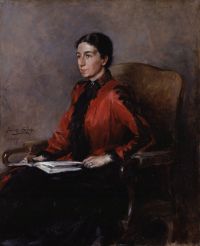
“ Of course one can't expect a girl of nineteen to behave like a schoolgirl. If you can induce her to take up some serious reading—Oh, I don't mean anything tremendous!—and to keep up her music—-I expect that's all her poor mother would have wanted. ”
Schoolgirl
Definition and stakes
The literary concept of the "schoolgirl" embodies the contrasts between youthful innocence and societal expectations, frequently depicted as a transitional stage between childhood and adulthood. Authors such as E. Lynn Linton portray her as someone bound by narrow perspectives and prone to transgression, while Fanny Fern highlights the lack of emphasis on practical education. Mrs.
Humphry Ward juxtaposes the schoolgirl’s perceived light-heartedness with the burdens of growing up, and Brenda Page examines her social interactions through competition and ethical challenges. These differing depictions emphasize the conflict between the idealized simplicity of school life and the increasing demands of adult roles, illustrating the schoolgirl as both a representation of untapped potential and a figure under cultural examination.
Quotes about “schoolgirl”
 E. Lynn Linton,
The Girl of the Period, and Other Social Essays…
E. Lynn Linton,
The Girl of the Period, and Other Social Essays…
“ Or she may be only a gauche and giggling schoolgirl, with a mind as narrow as her life, given up to the small intrigues and scandals of the dormitory and the playground—a girl who scamps her lessons and cheats her masters; whose highest efforts of intellect are shown in the cleverness with which she can break the rules of the establishment without being found out ”
 Fanny Fern,
A New Story Book for Children
(1864)
Fanny Fern,
A New Story Book for Children
(1864)
“ Where will you find a schoolgirl who does it neatly, now? who does not hate a needle, and most clumsily wields it when compelled to? and not by her own fault, poor thing! though her future husband may not be as ready as I to shield her with this excuse. Modern mothers never seem to think of this. Male teachers, with buttonless shirts on their own backs, seem to ignore it. No place for the needle in school, and no time, on account of long lessons, out. Where is a modern girl to learn this all-important branch of education, I want to know? ”
Ian Hay, The Lighter Side of School Life
“ Schoolgirls, we are given to understand, are prone to open their hearts to one another, or to some favourite teacher, with luxurious abandonment. Not so boys. Up to a point they are frankness itself: beyond that point lie depths which can only be plumbed by instinct and intuition—qualities whose possession is the only test of a born Housemaster. ”
William Barry Lord, The Corset and the Crinoline
“ All my pupils enjoy good health, my great secret being regular exercise, a point which is almost always disregarded. It appears from your correspondent's letter that the young lady did not experience any inconvenience after the first two years she was at the school, nor does her mother say her health was affected. She only complains that she is no longer a 'romping girl.' Now, no young lady of eighteen who expects to move in fashionable society would wish to be thought a romping schoolgirl. ”
Brenda Page, Schoolgirl rivals
“ The girls looked from one to another, but no one spoke or moved out of her place. "Someone in this room this evening is the culprit," continued the Principal, in her most impressive tones. "I will make my appeal to that girl, whoever she is. If she is sorry for an impulsive, unconsidered act, the finest way to show her repentance, and the way that calls for most moral courage, would be to come forward now in front of the whole school and confess her guilty intentions." ”
 Angela Brazil,
A Fourth Form Friendship: A School Story
Angela Brazil,
A Fourth Form Friendship: A School Story
“ Schoolgirls are thoughtless creatures, often very heartless, and it never struck the Form what pain they were inflicting upon a proud and sensitive lady, whose misfortunes obliged her to gain her living at an uncongenial occupation. ”
Mabel Quiller-Couch, Kitty Trenire
“ They laughed and scoffed at the usual simple tastes and amusements of schoolgirls, and, one being seventeen and the other eighteen, they considered themselves women, who, had it not been for their unkind stepmother, would have been out in society now instead of at school grinding away at lessons and studies quite beneath them. ”
Brenda Page, Schoolgirl rivals
“ Well, I shall probably call the whole school together for a public inquiry. Until then, I want you girls to understand that I do not wish the matter to go any farther. That will do, thank you, girls. I am sorry I have had to take up some of your time. ”
Various, Harper's Round Table, March 10…
“ We do not wish the girls in a school to be alike in everything. One day last October I sat on the platform of a woman's college during the opening exercises, and in the bright morning watched the long lines of girls march into the chapel to the sound of the piano. Two by two they came, dark girls and fair girls, plump girls and thin girls, tall girls and short girls, as sweet a band as I ever saw, all alert and alive and eager, and looking as if they never had an ache or a pain, as girls ought to look who have learned that health and vigor help to make successful students. ”
Rena I. Halsey, Blue Robin, the Girl Pioneer
“ Here is the “real thing” in a girl’s college story. Older authors can invent situations and supply excellently written general delineations of character, but all lack the vital touch of this work of a bright young recent graduate of a well-known college for women, who has lost none of the enthusiasm felt as a student. Every activity of a popular girl’s first year is woven into a narrative, photographic in its description of a life that calls into play most attractive qualities, while at the same time severely testing both character and ability. ”
 Mary Hayes Davis,
Chinese Fables and Folk Stories
(1908)
Mary Hayes Davis,
Chinese Fables and Folk Stories
(1908)
“ There were thirty-five scholars in the school at Qui-Chu, and three were girls. The boys played by themselves and the three girls played together. One day the teacher said to his mother, "I think I shall have the girls dress in boys' clothes next year, if they come to school." "Why will you do this?" asked his mother. "Because the boys do not like girls in the school. They will not play, read, or write with them. They tease them and laugh at them. I fear the girls must leave the school next year, and they are only nine years old. ”
Margaret Slattery, The Girl in Her Teens
“ By frequent illustrations 111 taken from life, the Sunday-school teacher may hope to make her see how true these things are. An absolutely unselfish girl may be, as those in their teens say she is, “impossible,” but the impossible can be made wonderfully attractive by the teacher who can picture the girl in her teens at her best. In her life in the everyday, no matter what her circumstances may be, the girl is constantly tempted to live below her best. ”
J. M. Wilson, Three Addresses to Girls at School
“ Women of our class may be, they ought to be, "benevolent institutions." And such women exist among us; pity is there are so few of them. They can unobtrusively be centres of happiness, and knowledge, and generous attitudes of mind. [Pg 36] Now there ought to be more of such women, and I look to our High Schools with hope. They ought to make girls public-spirited and large-minded.There is another element in girls' education which is only imperfectly as yet brought out, and which you yourselves can do something to develop. ”
 Jeannette Augustus Marks,
A Girl's Student Days and After
Jeannette Augustus Marks,
A Girl's Student Days and After
“ Here come some of the girls who are entering school and college with her—bright-haired, dark-haired, rosy or pale, tall and thin, fat and short, clever and average, desirable and undesirable,—in fact, all sorts and conditions of girls. Who is to be the leader of them all? She is the ideal freshman, a nice, well-set-up girl who does not think too much of herself, who is not self-conscious, and who does not forget for what she is sent to school. Despite the temptations of school life she uses her days wisely and well. ”
 George William Erskine Russell,
Seeing and Hearing
George William Erskine Russell,
Seeing and Hearing
“ Thus we have seen a lady Senior Wrangler and a lady Senior Classic, and I myself have the honour of knowing a sweet girl-graduate with golden hair, who got two Firsts at Oxford.The face of the earth is covered with Girls' High Schools, and Women's Colleges standing where they ought not. I am told, but do not know, that girl-undergraduates are permitted to witness physiological experiments in the torture-dens of science; and a complete emancipation in the matter of reading has introduced women to regions of thought and feeling which in old days were the peculiar domain of men. ”
Margaret Slattery, The Girl in Her Teens
“ In a hundred ways, both in teaching and in conversation with the girls, the Sunday-school teacher may show her own respect for the physical side of life, the marvel of it all, and the need on the part of every woman 24 to obey its unchanging laws, from which, if broken, there is no escape. In scores of ways she will frankly and naturally reveal to her girls her sympathy with womanhood everywhere, in every walk of life, and especially her respect for mothers, and her love for helpless childhood. ”
John Henry Goldfrap, The Motor Rangers on Blue Water… (1911)
“ Would you like to admit to your circle of friends the most charming of college girls—the typical college girl for whom we are always looking but not always finding; the type that contains so many delightful characteristics, yet without unpleasant perfection in any; the natural, unaffected, sweet-tempered girl, loved because she is lovable? ”
Jeannette Augustus Marks,
A Girl's Student Days and After
“ No doubt every girl would meet her obligations squarely if she realized what was the underlying significance of the freshman year; the school life would surely be approached with a conscientious purpose. What a girl gets in school will much depend upon what she has to give. No girl is there simply to have a good time or merely to learn things out of books. Nor is she there to fill in the interim between childhood and young womanhood, when one will go into society, another marry, and a third take up some wage-earning career. ”
Margaret Slattery, The Girl in Her Teens
“ When the teacher has resolved to make the effort to reach out for the girl who is leaving the Sunday-school in large numbers, the clear and challenging question, “What makes a class attractive to the girl in her teens?” ”
 Brand Whitlock,
The 13th District: A Story of a Candidate
Brand Whitlock,
The 13th District: A Story of a Candidate
“ The girls had been reared side by side, they had gone to the same school and, later, for a while, to the same college; and they had glowed over those secret passions of their young girlhood, just as they had wept when their lengthened petticoats compelled them to give up paper dolls. ”
Margaret Slattery, The Girl in Her Teens
“ But every Sunday-school teacher of girls in their teens has at least one girl whose mother does not or can not help at the time when help is most needed. Some have had no training themselves and do not see the need; some are crushed by the multitude of burdens, some are careless, and some have no knowledge as to how to cope with the wilfulness of girls which sometimes appears in the years of adolescence. ”
Annie H. Ryder, Hold Up Your Heads, Girls! Helps for Girls…
“ But, girls, I am talking chiefly to those among you who have left the high school or academy, and have reached an age when you have ideas of your own. I shall be glad when it is possible, in the college or the home, for every girl, who wishes, to follow, special or grouped studies; and when she will no longer censure herself because, outside of elementary knowledge of it, she is not acquainted with the study her neighbor is pursuing. ”
Thomas E. Sanders, Twenty Talks to Teachers (1908)
“ She is the giddiest of the giddy in talking about her beaux, and wonders why the school girls are so rude as to speak about their “fellows.”The pupils of another room—and often the same pupils under another teacher—are quiet, orderly, obedient, respectful and studious. She does not gush. She is not petty and has no pets. She is quiet, bright, cheerful, cheery, orderly, serious, natural, and has confidence in her pupils. She speaks kindly and affectionately of her boys and girls, neither thinking them faultless nor lauding them to the skies. Her every act is an inspiration to her pupils. ”
Jeannette Augustus Marks,
A Girl's Student Days and After
“ There is no denying that there is great temptation to violent admirations and attractions in school. In the first place, in school or college the girl is brought into contact with a large circle of people who are immensely interesting to her. The whole atmosphere is full of novelty, of the unusual. Some of the students and teachers whom she meets for the first time represent a broader experience, it may be, than her own home life has given her. They are often new types and new types are always interesting.I shall say nothing of the idealism of friendship—it plays its part in other books. ”
 Helen Leah Reed,
Brenda, Her School and Her Club
Helen Leah Reed,
Brenda, Her School and Her Club
“ Belle looked a little disturbed when she saw that there were to be but two students to escort them, and she forgot for the time being, that girls of less than sixteen can hardly expect to be considered young ladies by college undergraduates, who at the sophomore stage of existence are more inclined to the society of women a few years their senior. ”
Margaret Slattery, The Girl and Her Religion
“ The definite stand of such a group of interesting girls, easily leaders in school and the social life, made a decided difference in the standards of the young people of that community. The community as a whole, and the parents of the girls especially, owe to that teacher a very real debt for her part in the character building of those girls, who before they came in contact with her had had only vague and hazy ideas of a girl's duties and privileges. ”
J. M. Wilson, Three Addresses to Girls at School
“ It is the girls who are still in the High Schools, or who are passing out of them, or who are otherwise getting the higher education in a few private schools. "Ye are our epistle, known and read of all men," and read of all women too, with their still keener eyes.There is a very real danger in our High Schools that the intellectual side of education may be overestimated and overpressed, not by mistresses, but by yourselves ”
Lucy Helen Muriel Soulsby, Stray Thoughts for Girls
“ The clever girl who wins prizes and scholarships, helps our school to shine, and no one applauds her more than I do, but in my heart, I feel that the school owes even more to the dull plodding girl, who knows she cannot do much, but who determines to give her very best to the school, and to be worthy of it by giving no scamped work. ”
 Mrs. George de Horne Vaizey,
Tom and Some Other Girls: A Public School Story
Mrs. George de Horne Vaizey,
Tom and Some Other Girls: A Public School Story
“ I may persuade them to send me abroad for a year or so for languages and music, but even then I should be only twenty, and I can’t settle down to vegetate at twenty. It’s unreasonable to send a girl to a school where she is kept on the alert, body and mind, every hour of the day, and then expect her to be content to browse for the rest of her life! ”
Marguerite Dickson, Vocational Guidance for Girls
“ It is only very recently that anything like adequate knowledge of pupils has begun to be gathered and recorded to throw light upon the home-study question.School girls naturally divide into fairly well-defined classes: the girl who is overanxious or overconscientious about her work, the girl who intends to comply with rules but has no special anxiety about results, and the girl who habitually takes chances in evading the preparation of lessons. How many parents know at all definitely to which class their girl belongs? ”
Angela Brazil,
A Pair of Schoolgirls: A Story of School Days
“ Hope and Blanche sat still, with eyes that dared not raise themselves to meet those of the mistress."Very well; I am glad to find no others have broken the rule. For the rest of the term the six girls who so forgot themselves will not be allowed in the gymnasium between one and half-past two. If it is too wet to go into the playground, they must stay in the classrooms. Any of the six who enters the gymnasium during the prohibited time must report herself to me at once in the library. Thank you, Miss Carter. ”
G. S. Weaver, Aims and Aids for Girls and Young Women
“ We compare these educated girls with these educated young men, and wonder at the weakness of the female mind! The girls went to school because it was fashionable; the boys at the call of an honorable ambition. The girls studied to appear well in society; the boys to tread life's highway with honor and win laurels from the hand of the world in the duties of useful professions. The girls were stimulated by nothing that was great and noble in action; the boys were fired by all that can stir up human ambition. ”
Margaret Slattery, The Girl in Her Teens
“ When as teachers, interested in what we call the deepest things in the girl’s life, we are sometimes impatient with her light-heartedness, with the giggles and boisterous fun and “silliness” of the early teens, and the social tactics and sophistries of the later period, let us remember that the natural, healthy girl is “whole.” She is body, mind and spirit, and all three together make her a social being. ”
Josephine Chase, Grace Harlowe's Junior Year at High School
“ But are you willing to burden yourselves with some extra girls? You see it's this way. One of the things that [Pg 108] our sorority has pledged itself to do this year is to look up the stray girls in High School, and see that they are not lonely and homesick during holiday seasons. ”
