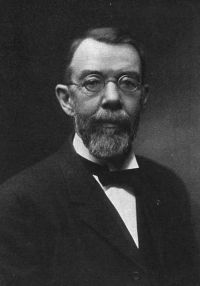
Adolf von Harnack and Arthur Cushman McGiffert

Biographical details

Adolf von Harnack and Arthur Cushman McGiffert 1911 Encyclopædia Britannica, Volume 25… (1911)

This indeed is characteristic of his Byzantine Christian point of view; church history becomes metamorphosed into a history of the emperors and of the state, because a special church history is at bottom impossible. But even so one hardly hears anything about state or court except great enterprises and anecdotes. Political insight is wholly wanting to Socrates; all the orthodox emperors blaze forth in a uniform light of dazzling splendour; even the miserable Arcadius is praised, and Theodosius II. figures as a saint whose exemplary piety turned the capital into a church.
Source: Wikisource

Adolf von Harnack and Arthur Cushman McGiffert 1911 Encyclopædia Britannica (1911)

In his characterizations of persons, borrowed from Socrates, he is more dull and colourless. After Socrates he has indeed repeated the caution not to be too rash in discerning the finger of God; but his way of looking at things is throughout mean and rustic. Two souls inhabit his book; one, the better, is borrowed from Socrates; another, the worse, is his own.
Source: Wikisource

Adolf von Harnack and Arthur Cushman McGiffert 1911 Encyclopædia Britannica, Volume 25… (1911)

If Socrates had lived about the year 325, he certainly would not have ranked himself on the side of Athanasius, but would have joined the party of mediation. But—the ὁμοούσιος has been laid down, and must be recognized as correctly expressing the mystery; only one ought to rest satisfied with that word and with the repudiation of Arianism. Anything more, every new distinction, is mischievous. The controversy in its details is a νυκτομαχία to him, full of misunderstandings.
Source: Wikisource

Get perspective with Kwize: daily news enlightened by great literature