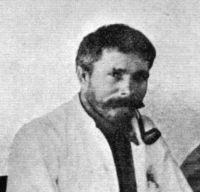
Cecil Champain Lowis

Biographical details

Cecil Champain Lowis,  The Tribes of Burma — The Three Migration Waves (1910)

“ Here and there, too, there has been such fusion of different tribes that even custom and legend is shared in common. What geography and history tell us is too often fallacious. It is language alone that shows relatively few anomalies and gaps and exhibits a development along the surest lines. So it is that if we are to attempt a classification of the peoples of Burma, we must look for our guide, not to chronicles or custom or folklore or propinquity on the map, but to speech, and only employ the other tests to check the criterion of language. ”
Source: Wikisource

Cecil Champain Lowis,  The Tribes of Burma — The Tibeto-Burman Wave (1910)

“ We must keep this crescent in mind when we consider the movement of the Tibeto-Burmans from the north, for along a considerable portion of its length it is practically an insuperable barrier, and it is clear that as the Tibeto-Burman tribes came down, some of them were brought up by its snow-clad heights and were obliged, if they wished to pursue their southerly course, either to come out east and follow the Salween southwards or fetch a circuit towards Assam and the Brahmaputra in the west and so reach hill-ridges and fresh valleys along which their way could be pursued. ”
Source: Wikisource

Cecil Champain Lowis,  The Tribes of Burma — The Three Migration Waves (1910)

“ We shall never be able to trace all the people who now inhabit Burma back fully to their original seats or say precisely where they had their beginnings as separate racial units and when they left their primaeval homes, but geography, philology and legend all help us to form a fairly shrewd general idea of their Genesis and roughly to trace their Exodus into the lands they ultimately occupied. Far north of Burma in Central Asia, where Tibet and China merge into one another, is the lofty cradle of great rivers. ”
Source: Wikisource

Get perspective with Kwize: daily news enlightened by great literature