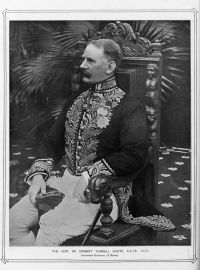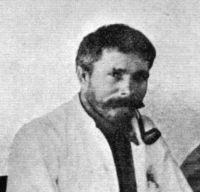
James George Scott

Biographical details

Portrait of James George Scott James George Scott,  1911 Encyclopædia Britannica, Volume 28… (1911)

“ Outside every village is an avenue of human skulls, amid groves conspicuous from long distances. These consist of strips of the primeval jungle, huge forest trees left standing where all the remaining country is cleared for cultivation. The undergrowth is usually cut away, and these avenues are commonly but not always in deep shade. ”
Source: Wikisource

Portrait of James George Scott James George Scott,  1911 Encyclopædia Britannica, Volume 4… (1911)

“ The fact that in Upper Burma the proportion of literates is nearly as high as, and the proportion of those under instruction even higher than, that of the corresponding classes in Lower Burma, is a clear proof that in primary education, at least, the credit for the superiority of the Burman over the native of India is due to indigenous schools. In almost every village in the province there is a monastery, where the most regular occupation of one or more of the resident pongyis, or Buddhist monks, is the instruction free of charge of the children of the village. ”
Source: Wikisource

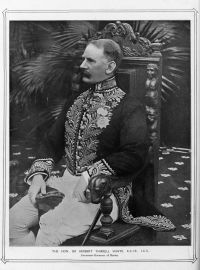
Portrait of James George Scott James George Scott,  1911 Encyclopædia Britannica, Volume 4… (1911)

“ The chief religious principle of the Burmese is to acquire merit for their next incarnation by good works done in this life. The bestowal of alms, offerings of rice to priests, the founding of a monastery, erection of pagodas, with which the country is crowded, the building of a bridge or rest-house for the convenience of travellers are all works of religious merit, prompted, not by love of one’s fellow-creatures, but simply and solely for one’s own future advantage. ”
Source: Wikisource

Get perspective with Kwize: daily news enlightened by great literature