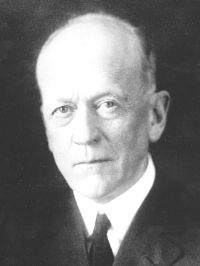
Charles Doolittle Walcott

Biographical details

Portrait of Charles Doolittle Walcott Charles Doolittle Walcott,  Cambrian Geology and Paleontology (1914)

“ With the development of the mapping of the geological formations of the United States, it has increasingly become evident that the use of more than one term derived from the same geographic name is faulty in principle and confusing in usage. I have long been guilty of doing it in the use of Georgian for the Lower Cambrian series of formations, and I now find that the name I derived Saratogan from, for the Upper Cambrian series, was previously used for the Cretaceous Saratoga formation. ”
Source: Wikisource

Portrait of Charles Doolittle Walcott Charles Doolittle Walcott,  Cambrian Geology and Paleontology (1914)

“ The great series of Cambrian and pre-Cambrian strata in eastern North America from Alabama to Labrador; in western North America from Nevada and California far into Alberta and British Columbia, and also in China, [2] have been studied and searched for evidences of life until the conclusion has gradually been forced upon me that on the North American Continent we have no known pre-Cambrian marine deposits containing traces of organic remains, and that the abrupt appearance of the Cambrian fauna results from geological and not from biotic conditions. ”
Source: Wikisource

Portrait of Charles Doolittle Walcott Charles Doolittle Walcott,  Description of a New Genus of the Order Eurypterida from the Utica Slate (1882)

“ The long curved spines (s, s, s) , are a very curious feature of the appendage and the most marked character of the genus and species. They are articulated to the posterior margin of the joints, as the latter rest flattened out in the slate or shale, and there is no evidence but that they formed a single series, as shown in the specimen and in the drawing, fig. 2. Each spine is constricted a little near its base, forming a rounded end or point of articulation ”
Source: Wikisource

Get perspective with Kwize: daily news enlightened by great literature