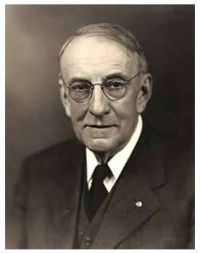
Dana Brackenridge Casteel

Biographical details

Dana Brackenridge Casteel The Behavior of the Honey Bee in Pollen Collection

Many pollen-bearing bees appear eager to receive food upon their return to the hive, and they will solicit it from other workers or take it from the honey-storage cells. The workers of the hive at times take a little of the fresh pollen from the baskets of the laden bee, nibbling it off with their mandibles or rasping off grains with their tongues.
Source: Gutenberg

Dana Brackenridge Casteel The Behavior of the Honey Bee in Pollen Collection

The sticky fluid which causes pollen grains to cohere is found upon all of the legs, in the region of their brushes, although the pollen combs and auricles of the hind legs are likely to show it in greatest abundance, since nearly all of the pollen within each basket has [26] passed over the auricle, has been pressed upward and squeezed between the auricle and the end of the tibia and the pollen mass above, and by this compression has lost some of its fluid, which runs down over the auricle and onto the combs of the planta.
Source: Gutenberg

Dana Brackenridge Casteel The Behavior of the Honey Bee in Pollen Collection

When the basket is fully loaded the mass of pollen extends laterally on both sides of the tibia, but projects much farther on the posterior side, for on this side the bounding row of hairs extends outward, while on the anterior edge the hairs are more curved, folding upward and over the basket. As the mass increases in thickness by additions from below it is held in position by these long hairs which edge the basket. They are pushed outward and many of them become partly embedded in the pollen as it is pushed up from below.
Source: Gutenberg

Get perspective with Kwize: daily news enlightened by great literature