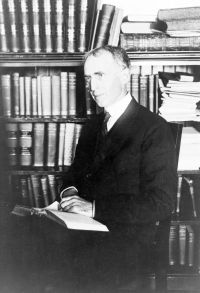
Francis Samuel Philbrick

Biographical details

Francis Samuel Philbrick,  1911 Encyclopædia Britannica, Volume 15… (1911)

“ Jefferson, in short, had unlimited faith in the honesty of the people; a large faith in their common sense; believed that all is to be won by appealing to the reason of voters; that by education their ignorance can be eliminated; that human nature is indefinitely perfectible; that majorities rule, therefore, not only by virtue of force (which was Locke’s ultimate justification of them) , but of right. [22] His importance as a maker of modern America can scarcely be overstated, for the ideas he advocated have become the very foundations of American republicanism. ”
Source: Wikisource

Francis Samuel Philbrick,  1911 Encyclopædia Britannica, Volume 14… (1911)

“ The rights of man lend dignity to the rights of Englishmen, and the broad outlook of a world-wide appeal, and the elevation of noble principles, relieve minute criticisms of an administrative system.
Jefferson’s political theory was that of Locke, whose words the Declaration echoes. Uncritical critics have repeated John Adams’s assertion that its arguments were hackneyed: so they undoubtedly were—in Congress, and probably little less so without,—but that is certainly pre-eminent among its great merits.
”
Source: Wikisource

Francis Samuel Philbrick,  1911 Encyclopædia Britannica, Volume 15… (1911)

“ The schools of thought for which they stood have since contended for mastery in American politics: Hamilton’s gradually strengthened by the necessities of stronger administration, as time gave widening amplitude and increasing weight to the specific powers—and so to Hamilton’s great doctrine of the “implied powers”—of the general government of a growing country; Jefferson’s rooted in colonial life, and buttressed by the hopes and convictions of democracy. ”
Source: Wikisource

Get perspective with Kwize: daily news enlightened by great literature