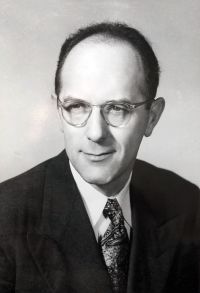
Herbert H. Ross

Biographical details

Portrait of Herbert H. Ross Herbert H. Ross,  How to Collect and Preserve Insects

“ A certain kind of insect may live only on a certain kind of plant, and to obtain the insect the collector must search or sweep the plant, called the host plant.
Many obscure places harbor insects seldom found elsewhere. Among these are leaf mold and debris on the surface of the soil, particularly in woods; rotten logs and stumps, which should be turned over to reveal insects that hide under or around them, and then carefully searched or torn apart for others that live inside; in, under, and around dead animals; under boards and stones.
Trees sometimes yield valuable specimens.
”
Source: Gutenberg

Portrait of Herbert H. Ross Herbert H. Ross,  How to Collect and Preserve Insects

“ This type of insect gradually gave rise to the orders which now contain the largest number of species, including the beetles, moths, and flies. In many lines of this neuropteroid branch, as it is called, the larva has become adapted to a mode of life quite different from that of the adult. Many fly larvae, for example, live in rotting organic material or live as parasites within the tissues of other kinds of insects, whereas the adult flies often feed at flowers on pollen and nectar, visiting the site of the larval habitat only to lay eggs. ”
Source: Gutenberg

Portrait of Herbert H. Ross Herbert H. Ross,  How to Collect and Preserve Insects

“ Evidence supporting this idea is found in insect embryos, which normally have rudimentary leg structures on the abdominal segments, and in some of the extremely primitive insects, which have rudimentary legs called styli on some segments of the abdomen. The result of this evolutionary development is a body having the front part, the thorax, specialized for locomotion and the back part, the abdomen, serving chiefly as a container for the vital organs, such as those of the digestive and reproductive systems. ”
Source: Gutenberg

Get perspective with Kwize: daily news enlightened by great literature