“ The moment that a volleyer fails to make a severe or at least a well-placed stroke, he is at a disadvantage, and would be better off in the back of the court than where he is. It is seldom that the two positions can balance, so to speak, and if a volleyer is not distinctly up, he is pretty sure to go down. Of course I do not mean that every ball that is to be volleyed should be smashed; far from it, but I do say that a volley should always be played hard on to the base-line or across the court to the side-line. If neither can be done, it is wrong to volley the ball at all. ”
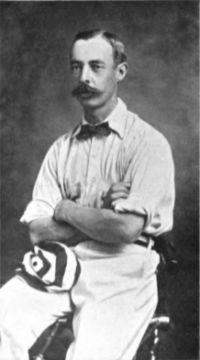
James Dwight
Biographical details

James Dwight (1852–1917), known as the “Founding Father of American Tennis,” played a key role in introducing the sport to the United States through his 1876 Nahant tournament, a landmark moment in tennis history. A Harvard graduate and prominent leader in the U.S. National Lawn Tennis Association (1881–1902), he influenced the development of early American tennis through his leadership, competitive spirit, and advocacy.
His publications, including Lawn-tennis and The Laws of Euchre, showcase his technical precision and strategic acumen, highlighting the importance of discipline and flexibility in play. Dwight’s influence continues today through his induction into the Hall of Fame (1955) and the lasting impact of his teachings on the sport’s ongoing evolution.
Quotes by James Dwight
“ I do not believe that it is right to smash a fairly good lob, but I think that it should be volleyed carefully, but still hard, far back in the court, and, if possible, into a corner. There is a long time to think as a lob drops, and many players lose heart and decide to play for safety instead of trying to kill the ball. As a matter of fact, it is safer to hit fairly hard, and the moment that a player begins to hit gently, for fear of putting the ball out of court, he descends to a lower level as a player and diminishes his own chance of success. ”
“ One is often asked the best method of learning to play. I fancy that the best way, could one often adopt it, would be to let a marker, as in a tennis-court, hit the balls gently to the beginner, pointing out to him his mistakes, so that he might not acquire a bad style. If he begins by going on to the lawn and playing a game, his only object will be to get the balls over the net, and he will be almost sure to fall into bad habits of play. ”
