“ The moment that a volleyer fails to make a severe or at least a well-placed stroke, he is at a disadvantage, and would be better off in the back of the court than where he is. It is seldom that the two positions can balance, so to speak, and if a volleyer is not distinctly up, he is pretty sure to go down. Of course I do not mean that every ball that is to be volleyed should be smashed; far from it, but I do say that a volley should always be played hard on to the base-line or across the court to the side-line. If neither can be done, it is wrong to volley the ball at all. ”
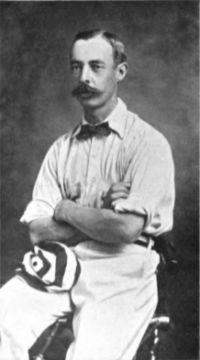
James Dwight
Summary
"Lawn-tennis," authored by James Dwight, is a treatise on the subtleties of the sport, focusing on technical execution, strategic play, and the mental demands of competition. Through detailed analysis of strokes, volleys, and match dynamics, Dwight emphasizes the importance of adaptability, accuracy, and focused practice.
The text critiques common mistakes, such as excessive bisque usage or overly cautious play, while promoting a balanced approach that combines aggression with tactical awareness. By examining the relationship between player skill, gear, and match strategy, Dwight provides a thorough guide to mastering the game’s intricacies.
Quotes from Lawn-tennis (James Dwight)
“ I do not believe that it is right to smash a fairly good lob, but I think that it should be volleyed carefully, but still hard, far back in the court, and, if possible, into a corner. There is a long time to think as a lob drops, and many players lose heart and decide to play for safety instead of trying to kill the ball. As a matter of fact, it is safer to hit fairly hard, and the moment that a player begins to hit gently, for fear of putting the ball out of court, he descends to a lower level as a player and diminishes his own chance of success. ”
“ It is very common to see a player who is losing take a bisque or two bisques almost at random, from a morbid fear of never taking them at all. In this way he adds a game or two to his score, but he forgets that it is sets, and not games, that win matches. It is far better to risk losing the set at six-love than to give up a chance of winning it by taking a bisque for the sake of saving one game. ”
