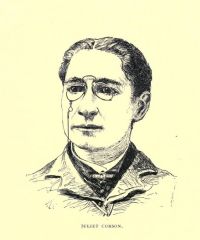
Juliet Corson

Biographical details

Portrait of Juliet Corson Juliet Corson A Course of Lectures on the Principles of Domestic Economy and Cookery

It is a question not only of taste but of economy whether you leave on the fat in addition to the first butter in which you browned the meat, a question of economy and nourishment. If the people you are cooking for have good strong digestions you do not need to remove the fat. The bread or potatoes which are eaten with the stew will absorb it and will render it perfectly digestible; and, of course, as I have already told you, the fat serves certain purposes in nutrition. If you are cooking for people having weak digestions then you would take the fat off the stew.
Source: Gutenberg

Portrait of Juliet Corson Juliet Corson Twenty-Five Cent Dinners for Families of Six

The most economical of soups, eaten with bread, will satisfy the hunger of the hardest worker. The absolute nutritive value of soup depends, of course, upon its ingredients; and these can easily be chosen in reference to the maintenance of health. For instance, the pot-liquor in which meat has been boiled needs only the addition of a few dumplings or cereals, and seasoning, to form a perfect nutriment. That produced from skin and bones can be made equally palatable and nutritious by boiling with it a few vegetables and sweet herbs, and some rice, barley, or oatmeal.
Source: Gutenberg

Portrait of Juliet Corson Juliet Corson Twenty-Five Cent Dinners for Families of Six

Before giving you receipts for cooking peas, beans, and lentils, I want to show you how important they are as foods. I have already spoken of the heat and flesh forming properties of food as the test of its usefulness; try to understand that a laboring man needs twelve ounces and a half of heat food, and half an ounce of flesh-food every day to keep him healthy. One pound, or one and a quarter pints of dried peas, beans, or lentils, contains nearly six ounces of heat food, and half an ounce of flesh food; that is, nearly as much heat-food, and more than twice as much flesh food as wheat.
Source: Gutenberg

Get perspective with Kwize: daily news enlightened by great literature