“ The whole party were in excellent spirits, and as happy as the birds that filled the woods and whose cheery "chick-a-dee-dee-dee," was heard whenever they paused to rest and let the hatchet be still. "How one sees everything in the colour of one's own spectacles," said Fleda. "May I ask what colour yours are to-day?" said Mr. Olmney. "Rose, I think," said Hugh. "No," said Fleda, "they are better than that--they are no worse colour than the snow's own--they shew me everything just as it is. It could not be lovelier." ”
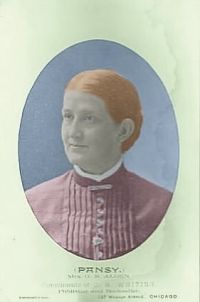
Susan Warner
Biographical details

Susan Bogert Warner (1819–1885), writing under the pen name Elizabeth Wetherell, was an American Presbyterian author celebrated for her religious fiction, children’s literature, and moral storytelling. Best known for her bestseller The Wide, Wide World, she also authored works such as Queechy, The Hills of the Shatemuc, and Melbourne House, delving into themes of faith, domestic life, and personal development.
Partnering with her sister Anna, she created semi-religious novels and Christian hymns, including “Jesus Bids Us Shine.” Her writing, once criticized as overly sentimental, has more recently been reassessed for its thoughtful depiction of gender roles and ethical thought, establishing her as a notable figure in 19th-century American literature.
Quotes by Susan Warner
“ But how do you mean it, Lois? Not to deny me? You do not mean that?""Yes," she said. And it was like putting a knife through her own heart when she said it. O, if she were at home! O, if she had never come on this drive! O, if she had never left Esterbrooke and those sick-beds!—But here she was, and must stand the question; and Mr. Dillwyn had not done."What reason do you give me?"—and his voice grated now with pain."I gave none," said Lois faintly. "Don't let us talk about it! It is no use. Don't ask me anything more!""One question I must. I must know it. Do you dislike me, Lois?" ”
 Susan Warner,
The Wide, Wide World
Susan Warner,
The Wide, Wide World
“ And the ride home was the best of all. The sun was low by the time they reached the plain; long shadows lay across their road; the soft air just stirred the leaves on the branches; stillness and loveliness were over all things; and down the mountain and along the roads, through the open country, the whole way, John walked at her bridle; so kind in his care of her, so pleasant in his talk to her, teaching her how to sit in the saddle, and hold the reins and whip, and much more important things, too, that Ellen thought a pleasanter thing could not be than to ride so. ”
Susan Warner,
A Red Wallflower
“ You should see England once, Miss Esther! That's the place for gardens; and the fields is allays green; and the flowers do be beautiful; and when the sun shines, it shines; here it burns.''Not to-day,' said Esther gleefully. 'How nice it is!'She might say so, for if the spring is rough in New England, and there is no denying it, there do nevertheless come days of bewitching, entrancing, delicious beauty, in the midst of the rest. Days when the air and sky and sunlight are in a kind of poise of delight, and earth beneath them, is, as it were, still with pleasure. ”
Susan Warner,
Queechy, Volume II
“ On the wavy white surface of the meadow land, or the steep hill- sides, lay every variety of shadow in blue and neutral tint; where they lay not, the snow was too brilliant to be borne. And afar off, through a heaven, bright and cold enough to hold the canopy over winter's head, the ruler of the day was gently preparing to say good-bye to the world. Fleda's eye seemed to be new set for all forms of beauty, and roved from one to the other as grave and bright as nature itself.For a little way, Mr. Carleton left her to her musings, and was as silent as she. ”
Susan Warner,
Hills of the Shatemuc
“ Elizabeth read; —"And a man shall be as an hiding-place from the wind, and a covert from the tempest; as rivers of water in a dry place; as the shadow of a great rock in a thirsty land.""Is that plainer?" he asked."It means the Saviour?" said Elizabeth."Certainly it does! To whom else should we go?""But Mr. Landholm," said Elizabeth after a minute's struggle, "why do you shew me this, when you know I can do nothing with it?""Will you do nothing?" he said.The words implied that she could; an implication she would not deny; but her answer was another burst of tears. ”
Susan Warner,
The Old Helmet, Volume I
“ It was the sense of want and pain in Eleanor's mind; not spoken indeed except by her countenance; but that toned strongly with the notes of feeling that were uttered around her. As from the bottom of a dark abyss into which he had fallen, a person might look up to the bright sky, of which he could see but a little, which yet would give him token of all the firmamental light and beauty up there which he had not. From her darkness Eleanor saw it; saw it in the preacher's face and words; yes, and heard it in many a deep-breathed utterance of gladness or thanksgiving at her side. ”
“ Fairyland never knew such a drive, surely. The afternoon was just right, as Norton had said; there was no dust, and not too much sun; the roads were in fine order; and they bowled along as if the ponies had had nothing to do in a great while. Now it was hardly within the memory of Matilda to have seen the country around Shadywalk as she saw it this afternoon. Every house had the charm of a picture; every tree by the roadside seemed to be planted for her pleasure. The meadows and fields of stubble and patches of ploughed land, were like pieces of a new world to the long housed child. ”
“ There was no disturbance in any of those sounds; nothing but joy and gladness and the voice of melody from them all.By and by, when the light began to kindle in the tops of the trees, and Daisy was sure to be watching it and trying to get sight of some of the bird singers which were so merry up there, she would hear another sound by her bedside, or feel a soft touch; and there would be Juanita, as bright as the day, in her way of looking bright, bending over to see and find out how Daisy was. ”
Susan Warner,
The End of a Coil
“ Mr. Copley leaned in a corner, laid his head against a cushion, and slept, or seemed to sleep. The other two were as silent; but I think both felt at the moment as if they would never sleep again. Rupert's face was in shadow; he watched Dolly's face which was in light. She forgot it could be watched; her eyes stared into the moonshine, not seeing it, or looking through it; the sweet face was so very grave that the watcher felt his heart ache. Not the gentle gravity of young maidenhood, looking into the vague light; but the anxious, searching gaze of older life looking into the vague darkness. ”
Susan Warner,
Queechy, Volume I
“ Twenty- four hours had wrought a sad change. The child looked as if she had been ill for weeks. Her cheeks were colourless; the delicate brow would have seemed pencilled on marble but for the dark lines which weeping and watching, and still more sorrow, had drawn underneath; and the beautiful moulding of the features showed under the transparent skin like the work of the sculptor. She was not crying then, but the open pages of the great bible had been wet with very many tears since her head had rested there."Fleda," said Mr. Carleton, after a moment, "you must come with me." ”
Susan Warner,
The Letter of Credit
“ Southwode might not prefer the sense and grace and spirit which breathed from every look and motion of Rotha's, to the doll beauty of her own daughter. Yet it was not insipid beauty either; the face of Antoinette was exceedingly pretty, the smile very captivating, and the white and peach-blossom very lovely in her cheeks. But for sense, or dignity, or sympathy with any thoughts high and noble, if one looked to Antoinette one would look in vain. No matter; hers was just a style which captivates men, Mrs. Busby knew; even sensible men,—the only danger as in possible comparison or contrast. ”
“ There was Pete, tall and very black, and very grave, as Darry was also. There was Jem, full of life and waggishness, and bright for any exercise of his wits; and grave shadows used to come over his changeable face often enough too. There was Margaret, with her sombre beauty; and old Theresa with her worn old face. I think there was a certain indescribable reserve of gravity upon them all, but there was not one whose lips did not part in a white line when looking at me, nor whose eyes and ears did not watch me with an interest as benign as it was intent. ”
Susan Warner,
The Old Helmet, Volume II
“ And still, as Eleanor stood there and looked and listened, the rush and the stir of sweet life grew more and more; the spring breeze wakened up and floated past her face bringing the breath of the flowers fresher and nearer; and the hill tops ever kindled into more and more glow. "It is Spring! and it is Day!" thought Eleanor,—"and so it is in my heart. The darkness is gone; the light is like that light,—promising more; my life is full of sweetness I never knew. Surely this month shall be the month of months to me for ever. ”
“ The blasting evil that had fallen upon them,--Fleda writhed on her bed when she thought of it. The sternest, cruellest, most inflexible, grasp of distress. Poverty may be borne, death may be sweetened, even to the survivors; but disgrace--Fleda hid her head, as if she would shut the idea out with the light. And the ruin it had wrought. Affection killed at the root,--her aunt's happiness withered, for this world,--Hugh's life threatened,--the fair name of his family gone,--the wear and weariness of her own spirit,--but that had hardly a thought. ”
Susan Warner,
Melbourne House, Volume 1
“ June went off, and Daisy was left alone. Very weary and exhausted, she sat leaning her head against the stone at her side, in a sort of despairing quiet. The little ripple of the water on the pebbly shore struck her ear; it was the first thing eye or ear had perceived to be pleasant that day. Daisy's thoughts went to the hand that had made the glittering river, with all its beauties and wonders; then they went to what Mr. Dinwiddie had said, that God will help his people when they are trying to do any difficult work for him; he will take care of them; he will not forsake them. ”
Susan Warner,
The Wide, Wide World
“ She began to cling more to that one unchangeable Friend from whose love neither life nor death can sever those that believe in him; and her heart, tossed and shaken as it had been, began to take rest again in that happy resting-place with stronger affection, and even with greater joy, than ever before. Yet for all that, this joy often kept company with bitter weeping; the stirring of anything like pleasure roused sorrow up afresh, and though Ellen's look of sadness grew less dark, Alice could not see that her face was at all less white and thin. ”
Susan Warner,
The Old Helmet, Volume I
“ Eleanor lived a very full life. It was no dull languid existence that she dragged on from day to day; time counted out none but golden pennies into her hand. Every minute was filled with business or play, both heartily entered into, and pursued with all the energy of a very energetic nature. Study, when she touched it, was sweet to her; but Eleanor did not study much. Nature was an enchanted palace of light and perfume. Bodily exertion, riding and walking, was as pleasant to her as it is to a bird to use its wings. Family intercourse, and neighbourly society, were nothing but pleasure. ”
Susan Warner,
Queechy, Volume II
“ The screen of trees was very thin on the border of this opening so thin that the light from beyond came through. On a slight rocky elevation, which formed the further side of it, sat an exquisite little Gothic chapel, about which, and the face of the rock below, some noisette and multiflora climbers were vying with each other, and just at the entrance of the further path a white dog-rose had thrown itself over the way, covering the lower branches of the trees with its blossoms.Fleda stood spell-bound a good while, with a breath oppressed with pleasure. ”
“ Daisy, as soon as she was free, had made her way to the window; there the child was, on her knees, her head on her window sill, and weeping as if her very heart were melting and flowing away drop by drop. And June stood like a dark statue, looking at her; the wrinkles in her forehead scarce testifying to the work going on under it. She wanted first of all to see Daisy in bed; but it seemed hopeless to speak to her; and there the little round head lay on the window-sill, and the moonbeams poured in lovingly over it. June stood still and never stirred. ”
Susan Warner,
Hills of the Shatemuc
“ Poor child, as she stood there the tears dropped fast, at that meeting of hope and sorrow; hope as intangible as the light, sorrow a thicker mantle than that of the cedar trees. And now the sunlight seemed to say 'Ask' — and the green glittering earth responded — "and ye shall receive." Elizabeth looked; — she heard them say it constantly. She did not question the one word or the other. It seemed very sweet to her, the thought of doing her duty; and yet, — the tears which had stayed, ran fast again when she thought of Mrs. Nettley's going away and how utterly alone she should be. ”
Susan Warner,
The End of a Coil
“ And this is how the world was meant to be, I suppose." "What do you mean? how?" said Christina. "It is rich to hear you talk." "Oh, look at it, Christina! Look at the colours and the lights and the sparkle everywhere, the perfect wealth of loveliness in form as well as colour; and if you think a minute you will know that He who made it all meant people to be happy, and meant them to be as full of happiness as the earth is full of beauty." "I don't see 'lights' and 'colours' so much as you do, Dolly; I am not an artist; but if God meant them to be happy, why aren't they happy?" ”
“ The eyes of the strangers glanced towards the old lady in her low chair at the front of the ox cart. In her wrinkled face there was not a line of beauty, perhaps never had been; in spite of its sense and character unmistakeable; it was grave, she was thinking her own thoughts; it was weather-beaten, so to say, with the storms of life; and yet there was an expression of unruffled repose upon it, as calm as the glint of stars in a still lake. Mrs. Lenox's look was curiously incredulous, scornful, and wistful, together; it touched Lois."One's young years ought not to be one's best," she said. ”
“ For my Aunt Gary made a bargain of everything. Wandering in thought as well, whither the sweet breath of the roses and geraniums led me, I went back to Molly in her cottage at Melbourne, and the Jewess geranium I had carried her, and the rose tree; and suddenly the thought started into my head, might not my dark friends at Magnolia, so quick to see and enjoy anything of beauty that came in their way—so fond of bright colour and grace and elegance—a luxurious race, even in their downtrodden condition; might not they also feel the sweetness of a rose, or delight in the petals of a tulip? ”
“ No wonder if the energies which owed much of their strength to love's nerving, should at last give out, and Fleda's evening be passed in wearied slumbers. No wonder if many a day was given up to the forced quietude of a headache, the more grievous to Fleda because she knew that her aunt and Hugh always found the day dark that was not lightened by her sunbeam. How brightly it shone out the moment the cloud of pain was removed, winning the shadow from their faces and a smile to their lips, though solitude always saw her own settle into a gravity as fixed as it was soft. ”
Susan Warner,
The Wide, Wide World
“ Van Brunt, do not say that; I am not good at all I am full of wrong things.""Well, I wish I was full of wrong things, too, in the same way," said he."But I am," said Ellen "whether you will believe it or not. Nobody is good, Mr. Van Brunt. But Jesus Christ has died for us, and if we ask him, he will forgive us, and wash away our sins, and teach us to love him, and make us good, and take us to be with him in heaven. Oh! I wish you would ask him!" she repeated, with an earnestness that went to his heart. "I don't believe any one can be very happy that doesn't love him." ”
Susan Warner,
The End of a Coil
“ Copley had to wait longer. It came at last, the chop; and till it came Dolly said no more. Her father watched her, and watched her, and could not take his eyes off her. The flush on her cheek and the sparkle in her eye, the moisture still lingering on her eyelashes, how sweet she was! and how indefinably lovely! Dolly had grown into a woman; she had the presence and poise that belong to a high-bred woman; and yet she had not lost her girlhood nor grown out of its artless graces; and as Mr. Copley looked he saw now and then a very childlike trembling of the under lip. ”
Susan Warner,
Queechy, Volume II
“ The roses could not be sweeter to any one; but, in view of the launching away in to that distant sea-line, in view of the issues on the other shore, in view of the welcome that might be had there the roses might fade and wither, but her happiness could not go with their breath. They were something to be loved, to be used, to be thankful for but not to live upon; something too that whispered of an increased burden of responsibility, and never more deeply than at that moment did Fleda remember her mother's prayer never more simply recognised that happiness could not be made of these things. ”
Susan Warner,
Hills of the Shatemuc
“ How alone! — In the parlour after midnight, with the lamps burning as if the room were gay with company; herself, in her morning dress, on the sofa for a night's rest, and there on her blanket on the carpet, Clam already taking it. How it told the story, of illness and watching and desertion and danger; how it put life and death in near and strong contrast; and the summer wind blew in through the blinds and pushed the blinds themselves gently out into the room, just as Elizabeth had seen and felt in many a bright and happy hour not so long past. ”
“ Early, Diana always saw it; in those prime hours of day when strength, and freshness, and promise, and bright hope are the speech and the eye-glance of nature. How much help the people lose who lose all that! When the sun's first look at the mountains breaks into a smile; when morning softly draws off the veil from the work there is to do; when the stir of the breeze speaks courage or breathes kisses of sympathy; and the clear blue sky seems waiting for the rounded and perfected day to finish its hours, now just beginning. Diana often saw it so ”
“ Fleda!--I wouldn't have said a word if I had thought it would have worried you so." He would not indeed. But he had spoken as men so often speak, out of the depths of their own passion or bitterness, forgetting that they are wringing the cords of a delicate harp, and not knowing what mischief they have done till they find the instrument all out of tune,--more often not knowing it ever. It is pity,--for how frequently a discord is left that jars all life long; and how much more frequently still the harp, though retaining its sweetness and truth of tone to the end, is gradually unstrung. ”
Susan Warner,
The Wide, Wide World
“ What makes the peculiar charm of these long streams of pale light across the floor? and the shadowy brightness without?""You must tell," said Ellen; "I cannot.""You know we enjoy anything much more by contrast; I think that is one reason. Night is the reign of darkness, which we do not love; and here is light struggling with the darkness, not enough to overcome it entirely, but yet banishing it to nooks and corners, and distant parts, by the side of which it shows itself in contrasted beauty. Our eyes bless the unwonted victory." ”
Susan Warner,
Queechy, Volume II
“ Mrs. Rossitur was lying on the bed; but her first mood had changed, for at Fleda's soft word and touch she half rose up, and, putting both arms round her waist, laid her face against her. There were no tears still, only a succession of low moans, so inexpressibly weak and plaintive, that Fleda's nature could hardly bear them without giving way. A more fragile support was never clung to. Yet her trembling fingers, in their agony, moved caressingly among her aunt's hair and over her brow, as she begged her when she could, she was not able at first to let her know the cause that was grieving her. ”
“ The Pleasant Valley maples were flaunting in orange and crimson when the home journey was made. The fairest month of the year was in the prime of its beauty; the air had that wonderful clearness and calm which bids the spirit of the beholder be still and be glad, saying that there is peace and victory somewhere, and rest, when the harvest of life is gathered. Diana felt the speech, but thought nevertheless that for her, peace and victory were a good way off. She believed they would come, when life was done; the present thing was to live, and carry the burden and do the work. ”
“ By turns I watched the sunlight streaming along the turf and lighting the foliage of the trees on the other side of the dell; looking in a kind of dream, as if I were not Daisy nor this Magnolia in any reality. I suddenly started and awoke to realities as Darry began to sing,— "My Father's house is built on high, Far, far above the starry sky; And though like Lazarus sick and poor, My heavenly mansion is secure. I'm going home,— I'm going home,— I'm going home To die no more! To die no more— To die no more— I'm going home To die no more!" ”
“ Why his oxen didn't go distracted was a question; but the very vehemence and iteration of his cries at last drowned itself in Fleda's ear and she could hear it like the wind's roaring, without thinking of it. She presently subsided to that. With a weary frame, and with that peculiar quietness of spirits that comes upon the ending of a days work in which mind and body have both been busily engaged, and the sudden ceasing of any call upon either, fancy asked no leave and dreamily roved hither and thither between the material and the spirit world; the will too subdued to stir. ”