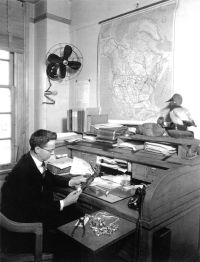
T. A. Coward

Biographical details

T. A. Coward The Migration of Birds

Mr Eagle Clarke says that the importance of winds is overstated, but as an incentive only. The direction of the wind has no influence as an incentive but its force is an important factor; in a strong wind a bird may be blown out of its course. Birds will not start in a high wind but may pass into the influence of strong winds which may affect both progress and direction. He adds that particular winds usually prevail during the season of great autumn movements, which are not incentives but are the result of pressure distribution which is favourable to migration.
Source: Gutenberg

T. A. Coward The Migration of Birds — Chapter 2 (1912)

But the lengthening of the journey might surely be occasioned in another way, and the evolution of migration assisted apart from any glacial influences. Each successive increase of the length of the journey taken by the stronger and more go—ahead individuals, leading them in advance of the bulk of southward moving and competing birds, would be a distinct advantage to the individual and consequently to the species. The pioneer would arrive, like the slower movers, in a land already peopled with an avian population, but it would not have its own fellows to add to the stress of competition
Source: Wikisource

T. A. Coward The Migration of Birds

In order to grasp the problems of migration it is necessary to get rid of the puerile and insular aspect of the subject, namely that migrants are merely those birds which come to us, like the swallow and cuckoo in the spring, and those, like the fieldfare and brambling, which visit us in winter but are not with us in summer.
Source: Gutenberg

Get perspective with Kwize: daily news enlightened by great literature