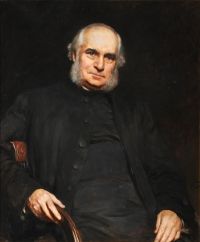
Thomas Andrew Archer

Biographical details

Thomas Andrew Archer Encyclopædia Britannica, Ninth Edition (1888)

These savages, entering from the north, flowed like a tide past the newly built and impregnable Templar fortress of Safed, swept down on Jerusalem, and annihilated the Christian army near Gaza on St Luke’s day (18th October) 1244. From this blow the Latin kingdom of the East never recovered; 600 knights took part in the battle; the whole army of the Tempars, 300 in number, was present, but only 18 survived, and of 200 Hospitallers only 16. The masters of both orders were slain or taken prisoners. Despite the admirable valour of the Templars, their policy had proved the ruin of the land.
Source: Wikisource

Thomas Andrew Archer 1911 Encyclopædia Britannica, Volume 28… (1911)

The undertaking to combine all human knowledge into a single whole was in itself a colossal one and could only have been born in a mind of no mean order. Indeed more than six centuries passed before the idea was again resuscitated; and even then it required a group of brilliant Frenchmen to do what the old Dominican had carried out unaided. The number of writers quoted by Vincent is almost incredible: in the Speculum Naturale alone no less than 350 distinct works are cited, and to these must be added at least 100 more for the other two Specula.
Source: Wikisource

Thomas Andrew Archer Dictionary of National Biography… (1888)

His exhaustion often caused him to fall asleep in his chair of office. On one occasion he dealt so subtly offhand with an intricate theological question that he could only explain his own eloquence by the theory of a special inspiration: the Holy Spirit had come in the form of a dove. On another occasion a Cistercian abbot brought seven of his pupils to hear Edmund's lecture, which so moved the strangers that they renounced the world.
Source: Wikisource

Get perspective with Kwize: daily news enlightened by great literature