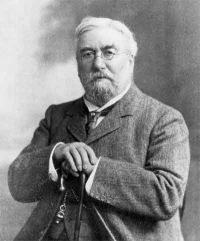
William C. Roberts-Austen and Francis H. Neville

Biographical details

William C. Roberts-Austen and Francis H. Neville 1911 Encyclopædia Britannica, Volume 1… (1911)

Our knowledge of the nature of solid alloys has been much enlarged by a careful study of the process of solidification. Let us suppose that a molten mixture of two substances A and B, which at a sufficiently high temperature form a uniform liquid, and which do not combine to form definite compounds, is slowly cooled until it becomes wholly solid. The phenomena which succeed each other are then very similar, whether A and B are two metals, such as lead and tin or silver and copper, or are a pair of fused salts, or are water and common salt.
Source: Wikisource

William C. Roberts-Austen and Francis H. Neville 1911 Encyclopædia Britannica, Volume 1… (1911)

Mixture by fusion is the general method of producing an alloy, but it is not the only method possible. It would seem, indeed, that any process by which the particles of two metals are intimately mingled and brought into close contact, so that diffusion of one metal into the other can take place, is likely to result in the formation of an alloy. For example, if vapours of the volatile metals cadmium, zinc and magnesium are allowed to act on platinum or palladium, alloys are produced.
Source: Wikisource

William C. Roberts-Austen and Francis H. Neville 1911 Encyclopædia Britannica, Volume 1… (1911)

For example, we can construct the curve of conductivity of alloys of two metals or the surface of conductivity of ternary alloys, and so on for any measurable property.
The electrical conductivity of a metal is often very much decreased by alloying with it even small quantities of another metal. This is so when gold and silver are alloyed with each other, and is true in the case of alloys of copper. When a pure metal is cooled to a very low temperature its electrical conductivity is greatly increased, but this is not the case with an alloy.
Source: Wikisource

Get perspective with Kwize: daily news enlightened by great literature