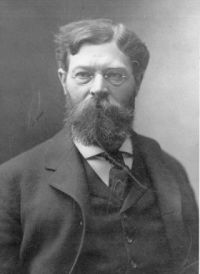
William De Witt Hyde

Biographical details

Portrait of William De Witt Hyde William De Witt Hyde Practical Ethics

Truth is the perception of things just as they are. Between truth and falsehood there is no middle ground. Either a fact is so, or it is not. "Truth," says Ruskin, "is the one virtue of which there are no degrees. There are some faults slight in the sight of love, some errors slight in the estimation of wisdom; but truth forgives no insult, and endures no stain." Truth does not always lie upon the surface of things. It requires hard, patient toil to dig down beneath the superficial crust of appearance to the solid rock of fact on which truth rests.
Source: Gutenberg

Portrait of William De Witt Hyde William De Witt Hyde The Five Great Philosophies of Life

The soul gives itself, alone, original, and pure, to the Lonely, Original, and Pure, who on that condition gladly inhabits it." "The higher the style we demand of friendship, of course the less easy to establish it with flesh and blood. We walk alone in the world. Friends such as we desire are dreams and fables. But a sublime hope cheers ever the faithful heart, that elsewhere, in other regions of the universal power, souls are now acting, enduring, daring, which can love us and which we can love."
Source: Gutenberg

Portrait of William De Witt Hyde William De Witt Hyde Practical Ethics

Only on the high plane of such absolute, whole-souled devotion can pure friendship be maintained.
THE VIRTUE.
The true friend is one we can rely upon.—Our deepest secrets, our tenderest feelings, our frankest confessions, our inmost aspirations, our most cherished plans, our most sacred ideals are as safe in his keeping as in our own. Yes, they are safer; for the faithful friend will not hesitate to prick the bubbles of our conceit; laugh us out of our sentimentality; expose the root of selfishness beneath our virtuous pretensions. "Faithful are the wounds of a friend."
Source: Gutenberg

Get perspective with Kwize: daily news enlightened by great literature