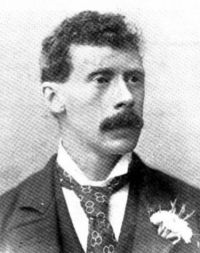
A. T. Quiller-Couch

A. T. Quiller-Couch

Summary

Portrait of A. T. Quiller-Couch A. T. Quiller-Couch The Talking Ships (1901)

HE was a happy boy, for he lived beside a harbour, and just below the last bend where the river swept out of steep woodlands into view of the sea. A half-ruined castle, with a battery of antiquated guns, still made-believe to protect the entrance to the harbour, and looked across it upon a ridge of rocks surmounted by a wooden cross, which the Trinity pilots kept in repair. Between the cross and the fort, for as long as he could remember, a procession of ships had come sailing in to anchor by the great red buoy immediately beneath his nursery window.
Source: Wikisource

Portrait of A. T. Quiller-Couch A. T. Quiller-Couch The Talking Ships (1901)

But for their riding-lights, the vessels at the buoy lay asleep. The crews of the foreigners had turned in; the Nubian, of Runcorn, had no soul on board but a night-watchman, now soundly dozing in the forecastle; and the Touch-me-not was deserted. The Touch-me-not belonged to the port, and her skipper, Captain Tangye, looked after her in harbour when he had paid off all hands. Usually he slept on board; but to-night, after trimming his lamp, he had rowed ashore to spend Christmas with his family—for which, since he owned a majority of the shares, no one was likely to blame him.
Source: Wikisource

Portrait of A. T. Quiller-Couch A. T. Quiller-Couch The Talking Ships (1901)

Across the avenue of teak which had been the Nubian's bulwarks he saw the Dutchman's galley, now a summer-house set in parterres of tulips. Beyond it the sails of the Maria Stella Maris, shaken from the yards, were piling themselves into snowy mountains, their foot-ropes and braces trailing down and breaking into leaves and clusters of the vine. He heard the murmur of streams flowing, the hum of bees, the whetting of the scythes; even the stir of insects' wings among the grasses.
Source: Wikisource

Get perspective with Kwize: daily news enlightened by great literature