Summary

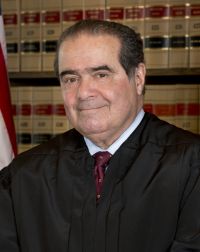
Portrait of Antonin Scalia Antonin Scalia Finley v. United States — Opinion of the Court

Whatever we say regarding the scope of jurisdiction conferred by a particular statute can of course be changed by Congress. What is of paramount importance is that Congress be able to legislate against a background of clear interpretive rules, so that it may know the effect of the language it adopts. All our cases-Zahn, Aldinger, and Kroger-have held that a grant of jurisdiction over claims involving particular parties does not itself confer jurisdiction over additional claims by or against different parties.
Source: Wikisource

Portrait of Antonin Scalia Antonin Scalia Finley v. United States — Opinion of the Court

Just as the statutory provision "between . . . citizens of different States" has been held to mean citizens of different States and no one else, see Kroger, supra, so also here we conclude that "against the United States" means against the United States and no one else. [5] "Due regard for the rightful independence of state governments . . . requires that [federal courts] scrupulously confine their own jurisdiction to the precise limits which the statute has defined."
Source: Wikisource

Portrait of Antonin Scalia Antonin Scalia Finley v. United States — Opinion of the Court

More precisely, it is not that the "statutory power to decide this case" is defeated by the joinder of a private party for purposes of a claim over which the District Court has no independent jurisdiction, but that the statutory power to decide a case including such a claim simply does not exist, since the FTCA provides jurisdiction only for claims against the United States.
Source: Wikisource

Get perspective with Kwize: daily news enlightened by great literature