Summary

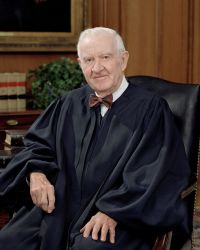
Portrait of John Paul Stevens John Paul Stevens Finley v. United States — Dissenting Opinion

The Court today adopts a sharply different approach. Without even so much as acknowledging our statement in Aldinger that before a federal court may exercise pendentparty jurisdiction it must satisfy itself that Congress "has not expressly or by implication negated its existence," 427 U.S., at 18, 96 S.Ct., at 2422, it now instructs that "a grant of jurisdiction over claims involving particular parties does not itself confer jurisdiction over additional claims by or against different parties."
Source: Wikisource

Portrait of John Paul Stevens John Paul Stevens Finley v. United States — Dissenting Opinion

III power in the federal judiciary to exercise subject-matter jurisdiction concerns whether the claims asserted are such as 'would ordinarily be expected to [be tried] in one judicial proceeding,' and the question of discretion addresses 'considerations of judicial economy, convenience and fairness to litigants.'↑ Federal jurisdiction is supported not only by the fact that the case is one arising under a law of the United States, but also that it is a controversy to which the United States is a party.
Source: Wikisource

Get perspective with Kwize: daily news enlightened by great literature