Summary

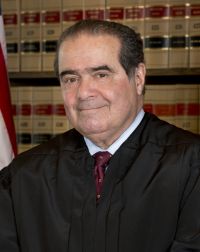
Portrait of Antonin Scalia Antonin Scalia Moskal v. United States — Dissenting Opinion

If the rule of lenity means anything, it means that the Court ought not do what it does today: use an ill-defined general purpose to override an unquestionably clear term of art, and (to make matters worse) give the words a meaning that even one unfamiliar with the term of art would not imagine. The temptation to stretch the law to fit the evil is an ancient one, and it must be resisted.
Source: Wikisource

Portrait of Antonin Scalia Antonin Scalia Moskal v. United States — Dissenting Opinion

The distinction between "falsity in execution" (or "false making") and "falsity of content" was well understood on both sides of the Atlantic as marking the boundary between forgery and fraud.
"The definition of forgery is not, as has been suggested in argument, that every instrument containing false statements fraudulently made is a forgery; but . . . that every instrument which fraudulently purports to be that which it is not is a forgery.
Source: Wikisource

Portrait of Antonin Scalia Antonin Scalia Moskal v. United States — Dissenting Opinion

Instead, the Court adopts a new principle that can accurately be described as follows: "Where a term of art has a plain meaning, the Court will divine the statute's purpose and substitute a meaning more appropriate to that purpose."
I feel constrained to mention, though it is surely superfluous for decision of the present case, the so-called rule of lenity-the venerable principle that "before a man can be punished as a criminal under the federal law his case must be plainly and unmistakably within the provisions of some statute."
Source: Wikisource

Get perspective with Kwize: daily news enlightened by great literature