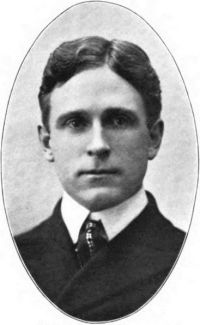
Archer Butler Hulbert

Archer Butler Hulbert

Summary

Portrait of Archer Butler Hulbert Archer Butler Hulbert Braddock's Road (1902)

Between the French and English colonies lay this black forest stretching from Maine through New York and Pennsylvania and Virginia to the Gulf of Mexico. It seemed, to the French, the silliest dream imaginable for the English to plan to pierce this forest and conquer New France. To reach any of the French forts a long passage by half-known courses through an inhospitable wilderness was necessary; and the French knew by a century of experience what a Herculean task it was to carry troops and stores over the inland water and land ways of primeval America.
Source: Wikisource

Portrait of Archer Butler Hulbert Archer Butler Hulbert Braddock's Road (1902)

The wagons are blocked in all conceivable positions on the hillsides. The condition of the horses is pitiful beyond description. If some are near to the brook or spring, others are far away. Some horses will never find water tonight. To the right and left the sentinels are lost in the surrounding gloom.
And then with those singing axes for the perpetual refrain, consider the mighty epic poem to be woven out of the days that have succeeded Braddock here. Though lost in the Alleghenies, this road and all its busy days mirror perfectly the social advance of the western empire to which it led.
Source: Wikisource

Portrait of Archer Butler Hulbert Archer Butler Hulbert Braddock's Road (1902)

The impetuous Beaujeu hurried off to the Indians and unfolded his plan to them. But they were afraid of Braddock; some of them had even gone into the English camp, at Cumberland, or in the mountains, on pretense of joining the English army; they had seen the long lines of grenadiers and wagons laden with cannon.
"How, my Father," they replied, "are you so bent upon death that you would also sacrifice us? With our eight hundred men do you ask us to attack four thousand English?
Source: Wikisource

Get perspective with Kwize: daily news enlightened by great literature