Summary

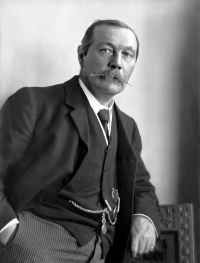
Portrait of Arthur Conan Doyle Arthur Conan Doyle The Stark Munro Letters — OAKLEY VILLAS, BIRCHESPOOL, 29th May… (1895)

Munro. sir." At last, however, his conversation became unbearable--a foul young man is odious, but a foul old one is surely the most sickening thing on earth. One feels that the white upon the hair, like that upon the mountain, should signify a height attained. I rose and bade him good-night, with a last impression of him leaning back in his dressing-gown, a sodden cigar-end in the corner of his mouth, his beard all slopped with whisky, and his half-glazed eyes looking sideways after me with the leer of a satyr.
Source: Wikisource

Portrait of Arthur Conan Doyle Arthur Conan Doyle The Stark Munro Letters — OAKLEY VILLAS, BIRCHESPOOL, 29th May… (1895)

I often wonder whether something of that wilt cling to our atoms--whether the dust of Johnnie Munro will ever have something of him about it, and be separable from that of Bertie Swanborough. I think it is possible that we DO impress ourselves upon the units of our own structure. There are facts which tend to show that every tiny organic cell of which a man is composed, contains in its microcosm a complete miniature of the individual of which it forms a part. The ovum itself from which we are all produced is, as you know, too small to be transfixed upon the point of a fine needle
Source: Wikisource

Portrait of Arthur Conan Doyle Arthur Conan Doyle The Stark Munro Letters — OAKLEY VILLAS, BIRCHESPOOL, 29th May… (1895)

If a comet were to strike this globule of ours, and to knock it into a billion fragments, which were splashed all over the solar system--if its fiery breath were to lick up the earth's surface until it was peeled like an orange, still at the end of a hundred millions of years every tiniest particle of our bodies would exist--in other forms and combinations, it is true, but still those very atoms which now form the forefinger which traces these words.
Source: Wikisource

Get perspective with Kwize: daily news enlightened by great literature