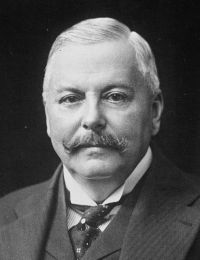
Arthur Everett Shipley

Arthur Everett Shipley

Summary

Portrait of Arthur Everett Shipley Arthur Everett Shipley 1911 Encyclopædia Britannica (1911)

Small and slight in person and never robust in health, Robertson Smith was yet a man of ceaseless and fiery energy; of an intellect extraordinarily alert and quick, and as sagacious in practical matters as it was keen and piercing in speculation; of an erudition astonishing both in its range and in its readiness; of a temper susceptible of the highest enthusiasm for worthy ends, and able to inspire others with its own ardour
Source: Wikisource

Portrait of Arthur Everett Shipley Arthur Everett Shipley 1911 Encyclopædia Britannica (1911)

The nervous system consists of a cerebral ganglion in the head, a conspicuous ventral ganglion in the trunk, and of lateral commissures uniting these ganglia on each side. The whole of this system has retained its primitive connexion with the ectoderm. The cerebral ganglion also gives off a nerve on each side to a pair of small-ganglia, united by a median commissure, which have sunk into and control the muscles of the head. As in other animals there is a minute but extensive nervous plexus, which permeates the whole body and takes its origin from the chief ganglia.
Source: Wikisource

Portrait of Arthur Everett Shipley Arthur Everett Shipley 1911 Encyclopædia Britannica (1911)

In the stomach it casts its membranes and becomes mobile, bores through the stomach walls and encysts usually in the body-cavity of its first and invertebrate host. By this time the embryo has all the organs of the adult perfected save only the reproductive; these develop only when the first host is swallowed by the second or final host, in which case the parasite attaches itself to the wall of the alimentary canal and becomes adult.
A curious feature shared by both larva and adult is the large size of many of the cells, e.g. the nerve cells and the bell.
Source: Wikisource

Get perspective with Kwize: daily news enlightened by great literature