Summary

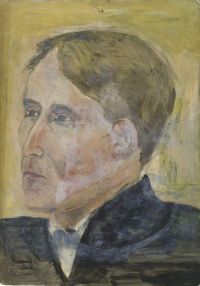
Portrait of Arthur Waley Arthur Waley The Nō Plays of Japan

The drum, strange damask drum.
Oh, will it never sound?
I thought to beat the sorrow from my heart,
Wake music in a damask drum; an echo of love
From the voiceless fabric of pride!
[137]
GARDENER.
Longed for as the moon that hides
In the obstinate clouds of a rainy night
Is the sound of the watchman’s drum,
To roll the darkness from my heart.
CHORUS.
I beat the drum. The days pass and the hours.
It was yesterday, and it is to-day.
GARDENER.
But she for whom I wait
CHORUS.
Comes not even in dream. At dawn and dusk
GARDENER.
No drum sounds.
CHORUS.
She has not come.
Source: Gutenberg

Portrait of Arthur Waley Arthur Waley The Nō Plays of Japan

No actor is on the stage, no word is uttered, but the sharp rap sounds with the thimbled finger as on a box and the stumpy little thud of the bare hands follows, or coincides, from the second drum and both players give a crooning whoop. In some way, which I can’t catch, that rhythm surely plays into the measure of the recitation when it comes and into the movements of the actors when they come. You know how people everywhere will persist in justifying the admirable in an art on the ground of the beautiful ideas it presents.
Source: Gutenberg

Portrait of Arthur Waley Arthur Waley The Nō Plays of Japan

The stage-wait necessitated by the change of costume and mask is filled in by an interminable sayer of short lines, with the same number of feet, each line detached from the next as if the speaker were going from one afterthought to another. He is a bystander—perhaps a shepherd in one play and a fisherman in another—who knows something, and dilates on it to fill in time. The musicians lay aside their drums. Everybody just waits. Up sweeps the curtain, and with the re-entry of the revealed personage comes the intenser and quicker second part for which the slow first part was a preparation.
Source: Gutenberg

Get perspective with Kwize: daily news enlightened by great literature