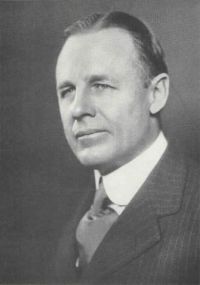
Benedict Crowell

Benedict Crowell

Summary

Portrait of Benedict Crowell Benedict Crowell Demobilization (1921)

It took seven million workers, men and women, to operate the war industrial machine—seven million Americans delving in the earth for ores, chemicals, and fuels, felling the forests, quarrying the rocks, carrying the raw materials to the mills, tending the fires and the furnaces, operating the cranes, guiding the finishing machinery with a precision never before demanded, slaughtering the beeves, curing the meat, packing the vegetables, weaving the fabrics, fashioning the garments, transporting all, and accomplishing the million separate tasks necessary to the munitioning of the Army.
Source: Gutenberg

Portrait of Benedict Crowell Benedict Crowell Demobilization (1921)

The American host which crossed to France went, almost to a man, uplifted and made heroic by the feeling that it was an army of crusaders fighting to end wars forever. No mere instinct of self-preservation, no simple prospect of a victory over a strange, foreign enemy in gray uniforms, could have inspired the morale of the American Expeditionary Forces, nor yet that of the forces in training in the United States, nor that of American industry in its eager, headlong devotion to the national undertaking.
Source: Gutenberg

Portrait of Benedict Crowell Benedict Crowell Demobilization (1921)

Governments fell as the war-ridden peoples of the earth blindly and brutishly vented their spleen and irritation for the hardships they had experienced upon those who chanced to be in power. Erstwhile statesmanship lapsed into a narrow, advantage-seeking partizanship that regarded not, it sometimes seemed in this country, even the fate of the world. The United States turned its back upon the League of Nations, which was the most ambitious attempt ever made by the nations of the earth to substitute a rule of reason for the rule of force.
Source: Gutenberg

Get perspective with Kwize: daily news enlightened by great literature