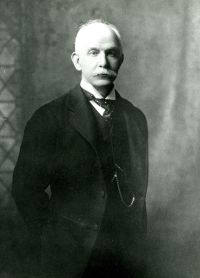
Brooks Adams

Brooks Adams

Summary

Portrait of Brooks Adams Brooks Adams The Theory of Social Revolutions… (1913 | notes)

In fine, money is the weapon of the capitalist as the sword was the weapon of the mediaeval soldier; only, as the capitalist is more highly specialized than the soldier ever was, he is more helpless when his single weapon fails him. From the days of William the Conqueror to our own, the great soldier has been, very commonly, a famous statesman also, but I do not now remember, in English or American history, a single capitalist who has earned eminence for comprehensive statesmanship.
Source: Wikisource

Portrait of Brooks Adams Brooks Adams The Theory of Social Revolutions… (1913 | notes)

And as capital has had now, for more than one or even two generations, all the prizes of the law within its gift, this attitude of capital has had a profound effect upon shaping the American legal mind. The capitalist, as I infer, regards the constitutional form of government which exists in the United States, as a convenient method of obtaining his own way against a majority, but the lawyer has learned to worship it as a fetich.
Source: Wikisource

Portrait of Brooks Adams Brooks Adams The Theory of Social Revolutions… (1913 | notes)

The capitalist seems incapable of feeling his responsibility, as a member of the governing class, in this respect, and that he is bound to uphold the law, no matter what the law may be, in order that others may do the like. If the capitalist has bought some sovereign function, and wishes to abuse it for his own behoof, he regards the law which restrains him as a despotic invasion of his constitutional rights, because, with his specialized mind, he cannot grasp the relation of a sovereign function to the nation as a whole.
Source: Wikisource

Get perspective with Kwize: daily news enlightened by great literature