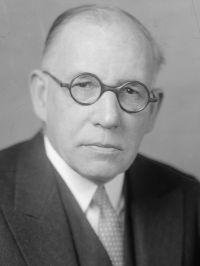
Carlton Joseph Huntley Hayes

Carlton Joseph Huntley Hayes

Summary

Portrait of Carlton Joseph Huntley Hayes Carlton Joseph Huntley Hayes The American Historical Review (1917)

THE HISTORY OF GERMAN SOCIALISM RECONSIDERED
In 1848 Marx and Engels published the Communist Manifesto, that "birth-cry of modern Socialism" which, by its strident appeals to the demons of Revolution and proletarian Internationalism, was well calculated to affright divine-right monarchs and to terrify all respectable well-to-do bourgeois. "You have nothing to lose but your chains", cried the prophets of the new and awful dispensation: "you have a world to win; workingmen of all countries, unite!"
Source: Wikisource

Portrait of Carlton Joseph Huntley Hayes Carlton Joseph Huntley Hayes The American Historical Review (1917)

No one has ever employed greater means of force or acted in manner more unscrupulous. And the result? What has become of him? He had at his disposal for more than a quarter of a century the police, the army, the money, the power of the State, in short all the means of physical force, while we could oppose him only with our good right, our good conviction, our naked breasts—and we have conquered. Our arms have been the better. In time brute force must yield to the moral factors, to the logic of events. Bismarck retired in disgrace—and the Social Democracy is the strongest party in Germany.
Source: Wikisource

Portrait of Carlton Joseph Huntley Hayes Carlton Joseph Huntley Hayes The American Historical Review (1917)

The German soil, the German country belongs to us, the masses, as well as to them. If Russia, the citadel of cruelty and barbarism, the foe of all human civilization, should attack Germany in order to weaken and dismember her—and such a war could have no other aim—we should have as much or more at stake than those who are at the head of Germany, and we would resist the aggressor.
Source: Wikisource

Get perspective with Kwize: daily news enlightened by great literature