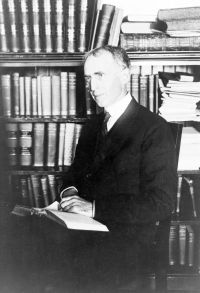
Charles A. Beard

Charles A. Beard

Summary

Portrait of Charles A. Beard Charles A. Beard History of the United States — II (1921)

For many a century the English had employed their fine woolen cloth as the chief staple in a lucrative foreign trade, and the government had come to look upon it as an object of special interest and protection. When the colonies were established, both merchants and statesmen naturally expected to maintain a monopoly of increasing value; but before long the Americans, instead of buying cloth, especially of the coarser varieties, were making it to sell. In the place of customers, here were rivals. In the place of helpless reliance upon English markets, here was the germ of economic independence.
Source: Wikisource

Portrait of Charles A. Beard Charles A. Beard History of the United States — II (1921)

So it happened that almost every kind of experiment in land tenure, from communism to feudalism, was tried. In the early days of the Jamestown colony, the land, though owned by the London Company, was tilled in common by the settlers. No man had a separate plot of his own. The motto of the community was: "Labor and share alike." All were supposed to work in the fields and receive an equal share of the produce. At Plymouth, the Pilgrims attempted a similar experiment, laying out the fields in common and distributing the joint produce of their labor with rough equality among the workers.
Source: Wikisource

Get perspective with Kwize: daily news enlightened by great literature