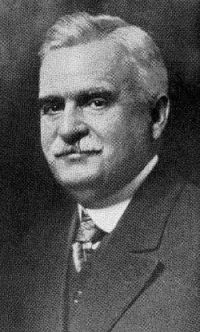
Charles DeLano Hine

Charles DeLano Hine

Summary

Portrait of Charles DeLano Hine Charles DeLano Hine Letters from an old railway official… (1904)

Like the ostrich, believing itself hidden with its head stuck in the sand, we feel that if we call them committees of our employes we are not recognizing the union. Is this consistent? We claim, and justly so, that a high principle is involved; that if we recognize the union we practically force every man to join, regardless of his own inclinations and of his freedom as an American citizen. This is sound doctrine, but its application is very faulty. Our spirit may be willing, but our flesh is damnably weak. Do we give the non-union man a show for his white alley?
Source: Wikisource

Portrait of Charles DeLano Hine Charles DeLano Hine Letters from an old railway official… (1904)

When a move is made to run out a non-union man, we are so afraid of being accused of holding somebody up that we put on the man the whole burden of making good.
Unionism, like religion, and like love, is the outgrowth of certain feelings and emotions in the human breast that strive to overcome the limitations of mankind; that seek to make an eternity of time, an ideal of an idea, a solid phalanx out of heterogeneous parts.
Source: Wikisource

Portrait of Charles DeLano Hine Charles DeLano Hine Letters from an old railway official… (1904)

The unions must learn that if they would be powerful, they must be severe as well as just. If they desire merely benevolent and comfortable care of their members they must put away the ambition for recognition. To be respected they must purge their ranks of the morally unfit. The union must expel the thief and the drunkard, as well as the thug and the ruffian, if justly discharged by the company, before it can hope to be trusted as a judge of capacity. It must learn that the American people will never stand for the closed shop, the restricted output, a limited number of craftsmen.
Source: Wikisource

Get perspective with Kwize: daily news enlightened by great literature