Summary

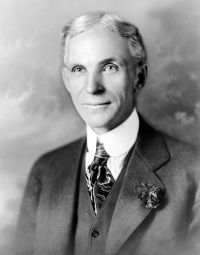
Portrait of Henry Ford Henry Ford My Life and Work — 18. Democracy and Industry (1922)

There is something sacred about a big business which provides a living for hundreds and thousands of families. When one looks about at the babies coming into the world, at the boys and girls going to school, at the young workingmen who, on the strength of their jobs, are marrying and setting up for themselves, at the thousands of homes that are being paid for on installments out of the earnings of men--when one looks at a great productive organization that is enabling all these things to be done, then the continuance of that business becomes a holy trust.
Source: Wikisource

Portrait of Henry Ford Henry Ford My Life and Work — 18. Democracy and Industry (1922)

You cannot preach patriotism to men for the purpose of getting them to stand still while you rob them--and get away with that kind of preaching very long. You cannot preach the duty of working hard and producing plentifully, and make that a screen for an additional profit to yourself. And neither can the worker conceal the lack of a day's work by a phrase.
Undoubtedly the employing class possesses facts which the employed ought to have in order to construct sound opinions and pass fair judgments. Undoubtedly the employed possess facts which are equally important to the employer.
Source: Wikisource

Portrait of Henry Ford Henry Ford My Life and Work — 18. Democracy and Industry (1922)

I am not opposed to labour organization. I am not opposed to any sort of organization that makes for progress. It is organizing to limit production--whether by employers or by workers--that matters.
The workingman himself must be on guard against some very dangerous notions--dangerous to himself and to the welfare of the country. It is sometimes said that the less a worker does, the more jobs he creates for other men. This fallacy assumes that idleness is creative. Idleness never created a job. It creates only burdens. The industrious man never runs his fellow worker out of a job
Source: Wikisource

Get perspective with Kwize: daily news enlightened by great literature