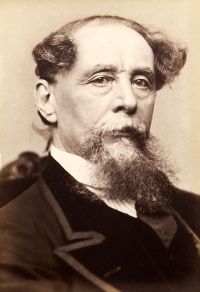
Charles Dickens

Charles Dickens

Summary

Portrait of Charles Dickens Charles Dickens Barnaby Rudge — Chapter 81 (1841)

Sir John let fall his glass; inclined his face towards him with an air of the most courteous inquiry; and slightly shook his head as though he were remarking to himself, ‘I fear this animal is going mad!’
‘I say you praise your own work very freely,’ repeated Mr Haredale.
‘Work!’ echoed Sir John, looking smilingly round. ‘Mine!—I beg your pardon, I really beg your pardon—’
‘Why, you see,’ said Mr Haredale, ‘those walls. You see those tottering gables. You see on every side where fire and smoke have raged. You see the destruction that has been wanton here.
Source: Wikisource

Portrait of Charles Dickens Charles Dickens Barnaby Rudge — Chapter 81 (1841)

Reclining, in an easy attitude, with his back against a tree, and contemplating the ruin with an expression of pleasure,—a pleasure so keen that it overcame his habitual indolence and command of feature, and displayed itself utterly free from all restraint or reserve,—before him, on his own ground, and triumphing then, as he had triumphed in every misfortune and disappointment of his life, stood the man whose presence, of all mankind, in any place, and least of all in that, he could the least endure.
Source: Wikisource

Portrait of Charles Dickens Charles Dickens Barnaby Rudge — Chapter 81 (1841)

You are a rough companion, but I would not go so far to avoid you.’
‘Listen to me,’ said Mr Haredale. ‘Listen to me.’
‘While you rail?’ inquired Sir John.
‘While I deliver your infamy. You urged and stimulated to do your work a fit agent, but one who in his nature—in the very essence of his being—is a traitor, and who has been false to you (despite the sympathy you two should have together) as he has been to all others. With hints, and looks, and crafty words, which told again are nothing, you set on Gashford to this work—this work before us now.
Source: Wikisource

Get perspective with Kwize: daily news enlightened by great literature